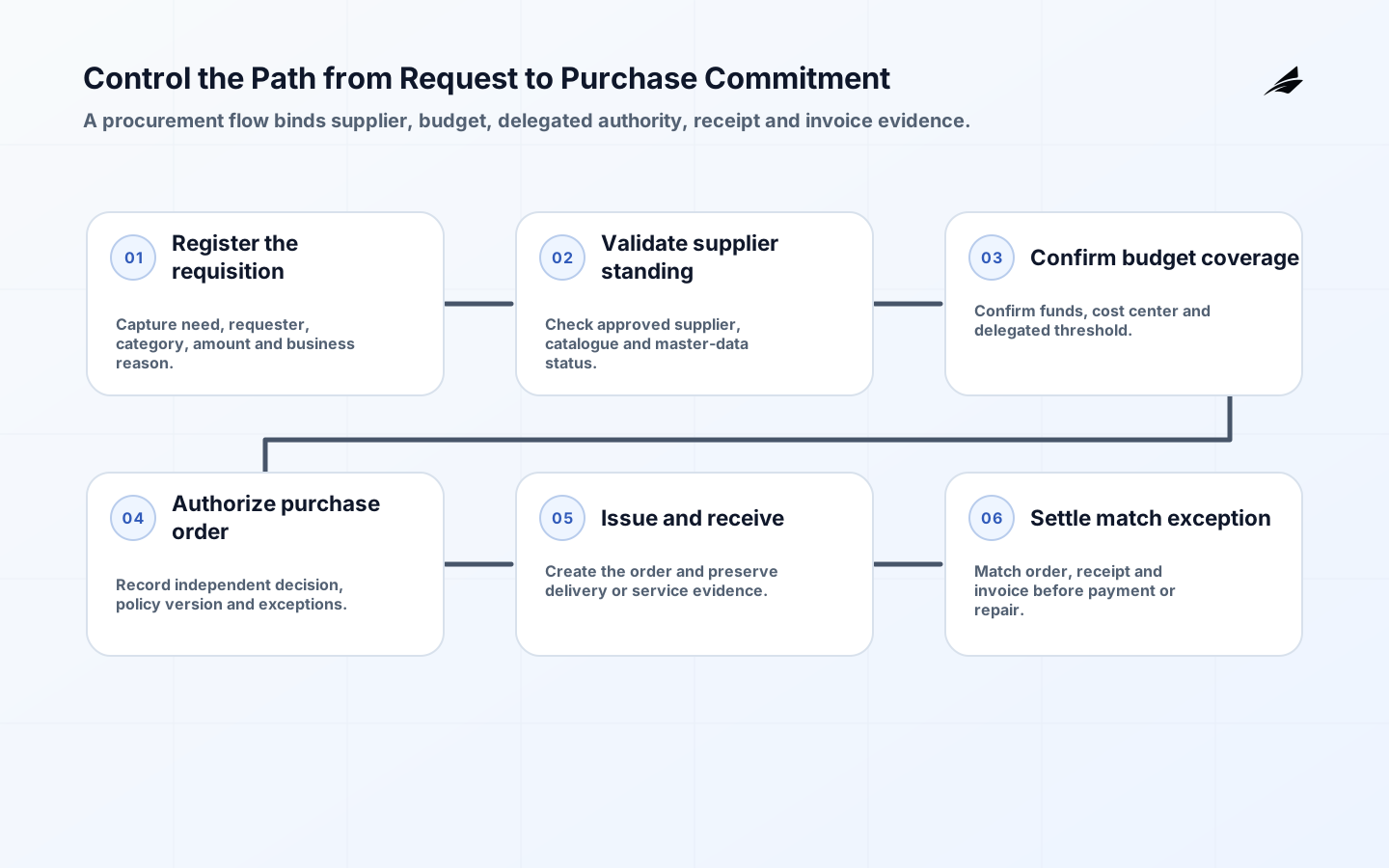
Procurement software is not a product-selection exercise disguised as a checklist. It is a way to decide whether a purchase request can become a committed order without bypassing policy, budget, or supplier controls. Start with one real operating decision, the people affected by it, and the evidence they need when something is disputed. For procurement software, that evidence usually spans requisition, supplier, catalogue item, approval, purchase order, receipt, and invoice match. Treat those records as an accountable chain rather than screens in separate products. The NIST Cybersecurity Framework is a useful reminder that risk management is an organizational practice, not a feature switch. Related guides on customer portal access design, system-of-record boundaries, enterprise reporting controls help clarify the neighboring boundaries.
Define the procurement software decision and boundary
Write the decision in plain language before configuring a workflow: “Can we show that a purchase request can become a committed order without bypassing policy, budget, or supplier controls?” Then name the procurement operations lead, the decision rights they hold, the users who may request or challenge an outcome, and the point at which a human must intervene. A useful procurement software boundary includes ordinary work, foreseeable exceptions, and the work that should be rejected or redirected. The critical trigger is not merely a technical error. It is a request exceeds a delegated threshold, lacks an approved supplier, or conflicts with a budget. This framing prevents teams from measuring click-through or completion while missing the real consequence: an unauthorized commitment, duplicate purchase, fraudulent supplier change, or invoice paid without evidence of receipt. A bounded decision also makes it possible to test changes against specific, observable cases instead of broad claims about transformation.
| Decision element | Question to settle | Evidence to keep |
|---|---|---|
| Accountable owner | Who can decide when procurement software may proceed? | Named role, approval limits, and escalation path. |
| Operating boundary | Which work is included, deferred, or rejected? | Entry criteria, prohibited states, and manual fallback. |
| Authoritative evidence | Which records establish the procurement software outcome? | requisition, supplier, catalogue item, approval, purchase order, receipt, and invoice match. |
| Failure response | What happens when evidence is missing or contradictory? | Queue owner, customer or staff message, and recovery decision. |
Build an evidence contract people can inspect
An evidence contract identifies each required record, its business meaning, source, owner, time basis, permitted use, and correction path. For procurement software, do not let a dashboard label or an integration field become the only definition. A reviewer must be able to see why a record exists, which rule acted on it, and whether a later change superseded it. The W3C PROV data model distinguishes entities, activities, and agents; that distinction is practical when a team needs to separate original evidence from a derived status or automated action. Keep stable identifiers across handoffs, retain the relevant rule or form version, and record who made material human judgments. This is what lets an operator reconcile a hard case without reopening every connected system.
- Give each critical procurement software record a business owner and technical contact.
- Record the applicable time: event time, effective time, approval time, or reporting period.
- Version rules, forms, and interface contracts so an outcome can be reproduced.
- Make corrections additive and explain their reason; do not overwrite the original evidence.
- Classify sensitive fields and state which roles or systems may receive them.
- Keep an accessible explanation for people who must act on a result.
Design the handoffs before integrating systems
Architecture is reliable when handoffs are explicit. Map where requisition, supplier, catalogue item, approval, purchase order, receipt, and invoice match enters, where it is validated, where an authoritative decision is made, and where a notification or downstream action is emitted. Each handoff needs an identifier, an expected state, a timeout, and an owner for the failed path. Use idempotent requests or a deduplication key where a retry could repeat an action. RFC 9110 is a helpful grounding for teams that expose or consume HTTP services: method and response semantics affect whether clients can safely retry and interpret a result. Publish only the minimum information required by the next actor. A consumer should not need to infer business authority from a display label or reconstruct a route from logs held by several vendors.
| Layer | Responsibility | Practical verification |
|---|---|---|
| Intake | Capture complete, attributable input and reject unsafe or malformed submissions. | Replay a valid case, an incomplete case, and a duplicated case. |
| Decision service | Apply documented authority, rules, and approval state. | Compare a sampled outcome with the policy and source evidence. |
| Work coordination | Create owned tasks, deadlines, and escalation states. | Trace one ordinary case and one stuck case end to end. |
| Publication and archive | Show the right status to the right audience and retain required evidence. | Check access, version, time basis, and retrieval after a change. |
Place controls at the point of consequence
A control is useful only when it changes the chance or impact of a harmful outcome. In procurement software, start where an unauthorized commitment, duplicate purchase, fraudulent supplier change, or invoice paid without evidence of receipt could occur. Require strong identity and role checks before exposing sensitive records; validate inputs before they become an authoritative state; and record approvals before an irreversible action. NIST SP 800-53 is a broad control catalogue, but its operational lesson is simple: controls should be selected for the risk and implemented with evidence of performance. Add a visible exception state instead of silently coercing data or retrying forever. A reviewer needs the original input, the relevant policy or rule version, the action already attempted, and authority to choose continue, correct, reverse, or stop.
Measure operating quality, not activity volume
Use measures that make a decision better. For procurement software, monitor cycle time from request to order, approved-catalogue use, exception age, three-way-match failures, and supplier-master change reviews. Segment measures by process stage, risk level, source, and user group when an aggregate could hide a serious failure. Pair quantitative signals with a small sample of real cases; high completion can coexist with poor explanations, inaccessible interaction, or unowned downstream work. OpenTelemetry Specification supports a disciplined approach to traces, metrics, and logs, but the instrument names matter less than the question each signal answers. Establish a baseline before a major release, document the denominator for every rate, and investigate unexplained movement before calling it an improvement.

- Measure the age and disposition of exceptions, not only their count.
- Keep a decision log for material manual overrides and compare similar cases.
- Alert on missing telemetry as well as adverse values; an unobserved path is not a healthy path.
- Review a sampled outcome with the staff and customers affected by it.
- Separate service-level targets from internal convenience metrics so urgent work is not obscured.
Release procurement software in a reversible sequence
Begin with one spend category with a named budget owner and a manual purchasing fallback. Run the proposed path alongside the existing controlled process long enough to compare outcomes, evidence, and workload rather than technical completion alone. Define beforehand what observation will justify expansion, what will require a pause, and who may make that call. Train the people who receive exceptions, provide a concise runbook with the actual escalation contact, and rehearse a dependency outage or incorrect rule deployment. Keep the manual route available until it is clear that the new path can preserve evidence and recover gracefully. Narrow early scope is a learning device: it exposes ambiguity in authority, data, and handoffs while limiting the consequence of an incorrect assumption.
Maintain the operating model after launch
After launch, hold a short recurring review led by the procurement operations lead. Bring system signals, a few ordinary cases, a difficult exception, and changes to upstream policy or organization structure. Ask whether the source still owns the same fields, the role still has the same authority, and the user-facing explanation still matches actual practice. Use recurring exceptions to distinguish a training problem from an unclear rule, a poor interface, a missing data source, or an unrealistic service target. W3C DCAT 3 offers useful concepts for describing assets and their context; apply that discipline to the operational register that teams actually use. Record material changes and their rationale so the next reviewer can tell deliberate evolution from unexplained drift.
Key takeaways
- Procurement software should begin with a named decision and accountable owner.
- Keep evidence, time basis, authority, and correction history together enough to inspect a disputed case.
- Design handoffs with stable identifiers, explicit states, and owners for failure paths.
- Put controls where a wrong result can cause an unauthorized commitment, duplicate purchase, fraudulent supplier change, or invoice paid without evidence of receipt.
- Expand only after a bounded release demonstrates useful outcomes and controlled recovery.
Procurement software FAQ
What is the smallest credible first scope? Choose one decision with a clear procurement operations lead, a finite user group, a manageable record boundary, and a manual fallback. For procurement software, the first release should produce evidence about real work, not merely show that systems can exchange a message.
How should exceptions be prioritized? Address the cases that can create an unauthorized commitment, duplicate purchase, fraudulent supplier change, or invoice paid without evidence of receipt, leave an affected person without an explanation, or prevent recovery of the original evidence. Then use exception age, recurrence, and risk band to decide which route or rule needs attention first.
When is a metric ready for management use? A procurement software metric is ready when its owner, definition, time basis, source boundary, known limitations, and action threshold are written down. A precise-looking number without that context is a prompt for investigation, not a reliable instruction.
Conclusion
Procurement software becomes dependable when it connects a real decision to inspectable evidence, explicit authority, controlled handoffs, and a recovery path people can use under pressure. The test is not whether every step is automated. It is whether the team can explain how an ordinary case proceeds, what happens when a request exceeds a delegated threshold, lacks an approved supplier, or conflicts with a budget, and who can correct a harmful result. That level of operational clarity makes procurement software easier to govern, safer to change, and more useful to the people whose work depends on it.