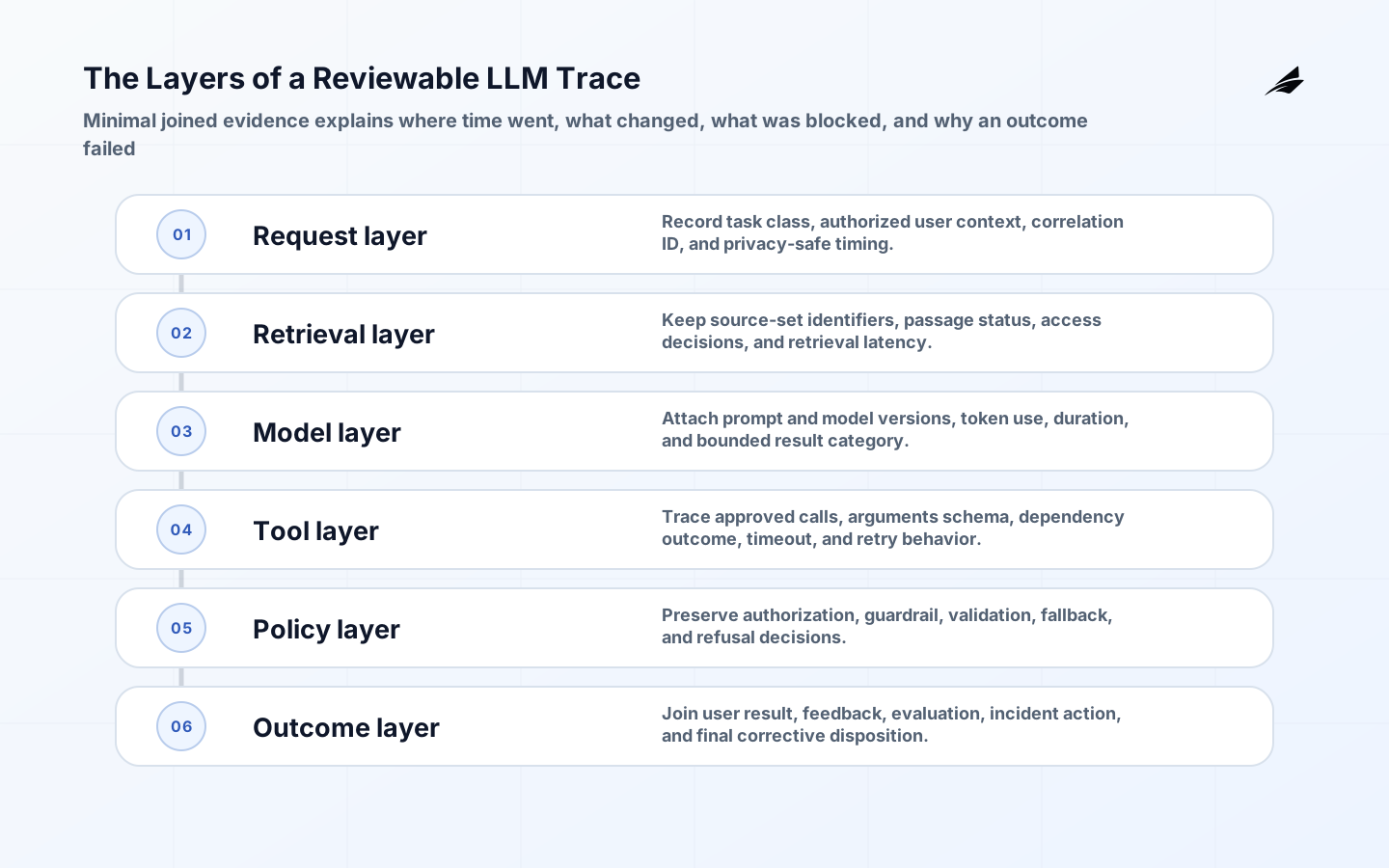
LLM observability is often discussed as a model feature, but for engineering teams it is an operating decision. In plain language, it is the collection and use of traces, metrics, events, and evaluation signals needed to understand how an LLM-enabled workflow behaved in operation. The useful question is not whether the technology sounds capable; it is whether it can find regressions and costly or unsafe paths quickly enough to correct them without collecting unnecessary sensitive content with evidence, accountability, and a recoverable failure path. This guide explains the work boundary, the controls that belong outside the model, and the measures that tell a team whether LLM observability is helping real work.
What LLM observability Means In Practice
A practical LLM observability implementation starts with one recurring moment of work, a named user, and a result that can be inspected. Observability is not a raw prompt archive. Capture the minimum data needed to reconstruct a decision while applying access, retention, and redaction rules. That distinction matters because an impressive demonstration may use curated inputs, invisible permissions, or a person quietly repairing every exception. The NIST Generative AI Profile recommends managing risks across the system lifecycle and context, which is exactly where operational ownership belongs.
| Question | Practical answer | Evidence to retain |
|---|---|---|
| Who benefits? | Name the user and the decision or task that becomes easier. | Workflow owner, trigger, and success criterion. |
| What may enter? | Use approved data, instructions, and tools with an explicit scope. | Source, version, access rule, and effective date. |
| What may happen? | State the permitted output or action and the required review. | Decision rule, approval path, and reason code. |
| How does it stop safely? | Define abstention, escalation, correction, and rollback. | Exception record, accountable owner, and outcome. |
Design The LLM observability Boundary
Write a one-sentence service contract before selecting a vendor or framework: “When this trigger occurs, the system may use these inputs to produce this bounded result for this owner.” Then name what it must not decide or change. That contract gives product, security, and operations a shared object to review. It also turns vague concerns about LLM observability into testable questions about data lineage, permissions, latency, failure impact, and human authority. The related model evaluation guide provides useful adjacent context without changing the responsibility of this workflow.
- Define the smallest outcome for which LLM observability is genuinely valuable, not merely interesting.
- Keep the authoritative record outside the model and identify the system that owns it.
- Make the user-visible result distinguish facts, inference, uncertainty, and the next permitted action.
- Give exceptions a queue, service expectation, and named owner rather than leaving people to improvise.
Build A Reviewable LLM observability Path
The implementation sequence should be define the operational questions first, instrument one critical path end to end, sample outputs for evaluation, and set owners and thresholds for alerts and review. Keep deterministic controls at the edges: authenticate the requester, authorize access at the protected operation, validate structured inputs, and persist a correlation identifier. OWASP's LLM application guidance is a useful reminder that prompt and data risks do not disappear because a response is fluent. The goal is a path an operator can reconstruct, not a black box that only works on the happy path.

| Failure condition | Design response | User-safe result |
|---|---|---|
| A new retrieval setting increases answer latency and citation failures, but logs contain only a final response so the team cannot separate retrieval, model, and tool delays. | correlate request, retrieval, model, tool, policy, and outcome events with a shared identifier; redact sensitive fields and protect access to traces | The workflow exposes a truthful status and does not overstate certainty. |
| Missing prerequisite | Validate required fields and policy before the consequential step. | The user receives a specific request for information or an escalation. |
| Repeated or delayed request | Use stable identifiers, idempotent processing, and inspectable state. | A retry does not duplicate work or silently change the outcome. |
| Unexpected result | Capture enough evidence to reproduce the path and route review. | The team can correct the record and improve the control. |
Test LLM observability Against Real Work
A meaningful test is built from representative work, including uncomfortable cases: incomplete records, conflicting sources, unusual language, a user without permission, and a dependency that responds late. When an internal assistant gives an unsupported answer, a trace should reveal the request class, retrieval set identifiers, prompt version, model configuration, policy decision, and user feedback without exposing more personal data than necessary. Test the normal result and the recovery result. Include the people who actually resolve exceptions; they often expose missing context or misleading states that a technical test alone will miss. Keep the fixtures versioned so later changes can be compared with a known baseline.
Operate And Measure LLM observability
Measure end-to-end latency, error and fallback rate, token and tool cost, evaluation pass rate, unsafe-output reports, and trace completeness. Pair quantitative signals with sampled case review. A metric can show a shift, but a traceable example explains whether the shift came from data freshness, a policy change, a model update, an integration failure, or changing user behavior. The UK guidance for secure AI system development reinforces the need to consider secure design, development, deployment, and operation as connected activities. Review ownership whenever the workflow, source, or user group changes.
Release LLM observability With Guardrails
For LLM observability, Release in stages: compare the new result with the current process, enable it for internal users or a small cohort, and agree the reversal condition before broader exposure. Record the version of prompts, models, retrieval settings, schemas, policies, and integrations that affect behavior. Do not treat a manual override as a silent fix. Each override is evidence about a missing rule, unclear interface, weak source, or inappropriate boundary. A short recurring review should convert that evidence into a concrete change, test, or documented decision.
Governance And Ownership For LLM observability
For LLM observability, decide in advance which question each signal must answer: where did time go, which source set was used, what policy blocked a request, or which change caused an evaluation regression. That prevents indiscriminate logging and gives incident responders a coherent trace. Sensitive prompts and outputs should be minimized, redacted, access-controlled, and retained only as long as the operational purpose requires.
Connect online signals with offline evaluation. Traces can identify a cohort or release that deserves investigation; labeled review can then determine whether behavior was actually helpful and safe. Set thresholds with named owners and an expected response, such as pausing a rollout, switching to a fallback, correcting a source, or opening a review. Telemetry without a decision path becomes expensive background noise.
Release Review For LLM observability
A durable LLM observability programme balances diagnostic value with data minimization. Define which identifiers and summaries are enough to join events across services, then avoid capturing raw material that is not needed for debugging, evaluation, or audit. Give incident responders a documented route from alert to trace to corrective action, and record the resolution outcome so repeated failures can be grouped. Revisit dashboards and alerts when models, tools, or source systems change; a metric that was useful for a prototype may miss the failure modes of a production workflow. Observability becomes valuable when it shortens the path from signal to a responsible decision.
Evidence Review For LLM observability
Evidence review for LLM observability should tie technical events to user outcomes. For a sample of slow, failed, or unsafe interactions, verify that the trace explains enough to locate the contributing layer and that the resolution was recorded. Look for blind spots created by new models, tools, source systems, or policy checks. Also examine what data was retained and whether access remained appropriate. A useful observability review may remove noisy events as readily as it adds a new metric. The objective is a focused record that helps a responsible operator understand and improve the workflow without turning routine operations into uncontrolled surveillance.
LLM observability Takeaways
- LLM observability should serve a named workflow outcome with a clear owner.
- Keep source facts, authorization, and consequential side effects under explicit application controls.
- Test failure, ambiguity, and recovery alongside the normal path.
- Use operating evidence to decide whether to expand, correct, or stop the capability.
LLM observability FAQ
Where should a team start? Start with a narrow workflow where the team can find regressions and costly or unsafe paths quickly enough to correct them without collecting unnecessary sensitive content and a human can review the result. What makes it ready for broader use? A team should be able to demonstrate the normal path, a meaningful failure, the evidence behind a result, and a safe correction. Is an AI model the whole solution? No. LLM observability depends on product rules, data quality, permissions, interfaces, and accountable operations around the model. What should leaders ask for? Ask for an owner, an explicit boundary, representative tests, measurable signals, and an exception path that works during a busy day.
Before expanding LLM observability, run a tabletop investigation from an alert to a corrective action. Confirm that an on-call engineer can find the relevant trace, interpret the release and policy versions, access only the data they need, and decide whether to roll back, route a case, or open evaluation. That exercise validates observability as an operational capability rather than a collection of dashboards.
Conclusion: Make LLM observability Accountable
The useful test for LLM observability is straightforward: can the right person understand what happened, see the evidence, and take the next safe action? Build the smallest workflow that meets that test, observe it in real conditions, and widen its scope only when the operating evidence supports it.