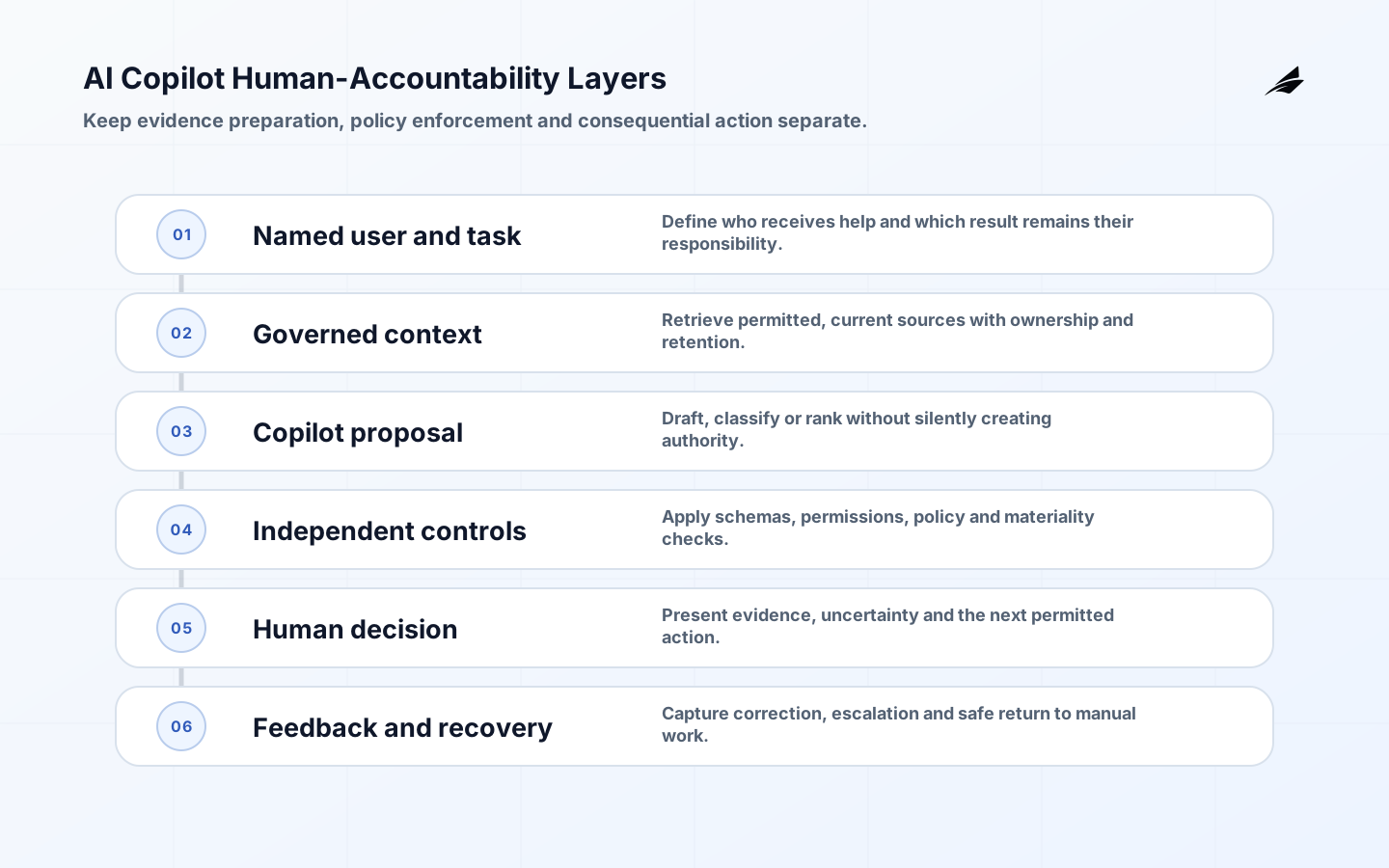
AI copilots are not a feature category to approve in the abstract. It is an operating choice: a person remains responsible while a copilot prepares evidence, drafts, or next steps. This ai copilots checklist is for product teams who need to move from a promising demonstration to a service that can be explained during a busy day. Start with one recurring decision, name the evidence that may enter, and state what remains a human or conventional software responsibility. The companion AI copilots field guide gives the deeper foundation; this page turns that foundation into a release checklist. For this part of the system, name the accountable owner, supporting evidence, exception route, and next measurable check.
Define The Work And Owner
For product teams working on ai copilots, this ownership decision should connect governed inputs, model behavior, permitted tools, human judgment, and recorded outcomes to evidence an accountable owner can inspect. Write a one-sentence operating statement before selecting models, frameworks, or vendors. Include the user, trigger, permitted inputs, desired result, prohibited actions, and accountable owner. A useful statement is observable: “when a service request arrives, prepare a cited recommendation for the queue lead,” not “improve support with AI.” That distinction prevents scope drift, makes acceptance tests possible, and gives a reviewer a place to stop an unsafe expansion. In this implementation review, move beyond the ownership decision only after the owner can show the accepted result, the exception path, and the signal for another review.
| Decision question | Practical answer | Evidence to retain |
|---|---|---|
| Who owns the outcome? | Name a process owner and a technical owner with distinct responsibilities. | Owner, escalation route, and review cadence. |
| What is the work boundary? | Describe one trigger, one result, and excluded actions. | Operating statement and test cases. |
| Which records are allowed? | Use approved, attributable sources with known access rules. | Source ID, version, owner, and access decision. |
| What happens when evidence is weak? | Abstain, request clarification, or route a review task. | Reason code and final disposition. |
Prepare Governed Inputs
Treat inputs as records with lifecycle and permissions, not as convenient text. Role boundaries, grounded context, feedback capture, and clear handoff should be explicit before information is selected or persisted. Capture the source owner, effective date, access classification, and withdrawal path. This is especially important when a record contains instructions or prior decisions: content may be evidence, but it must not silently rewrite the workflow. The NIST Generative AI Profile is helpful here because its risk lens covers the system and its context, not a model response alone. When implementing this part of the system, name the accountable owner, supporting evidence, exception route, and next measurable check.
- Maintain a register for inputs used by AI copilots, including owner, version, audience, retention rule, and freshness expectation.
- Apply identity and authorization checks before context selection, not only before a final screen is displayed.
- Keep source references beside the result so a reviewer can test whether the evidence actually supports it.
- Define a correction route for stale, disputed, or wrongly classified material and record the correction outcome.
Design A Reviewable Path
In ai copilots, product teams should make the relationship between governed inputs, model behavior, permitted tools, human judgment, and recorded outcomes explicit and reviewable. Make the route from request to result legible. Separate interpretation from authority: an AI component can classify, extract, draft, rank, or propose, while application services enforce policy, schemas, approvals, and side effects. Version the instructions, retrieval settings, tools, parsers, and policies that may change behaviour. That record is not bureaucracy; it lets an operator distinguish a source problem from a configuration regression. This guide to human-in-the-loop automation is a useful adjacent design reference when the path grows beyond its first bounded use case. This implementation review should close the operating decision only when the result, unresolved exception, and next review condition are recorded.

| Path stage | Required control | Safe failure behaviour |
|---|---|---|
| Request intake | Authenticate the user and validate task scope. | Reject ambiguous or unauthorised requests with a usable explanation. |
| Context or input selection | Filter by access, status, and relevance. | Return less context or no result when evidence is insufficient. |
| Inference or transformation | Constrain format and retain configuration version. | Expose uncertainty rather than inventing a complete answer. |
| Decision or action | Enforce policy and authority outside the model. | Require approval, dry run, or escalation before a side effect. |
| Record and review | Store evidence, output, and disposition for authorised review. | Preserve the event and open a correction task. |
Test Real Failure Modes
Evaluate the work against representative cases rather than a polished demo. Include ordinary requests, missing data, conflicting records, disallowed requests, and time-pressure cases. One failure to test deliberately is this: A copilot presents a suggestion as settled fact, so the user cannot see its uncertainty. Decide what should happen, who sees the exception, and how the team learns from it. The OWASP Top 10 for LLM applications is a practical threat catalogue for issues such as prompt injection, sensitive-information disclosure, insecure output handling, and excessive agency. While operating this evaluation, name the accountable owner, supporting evidence, exception route, and next measurable check.
Measure Release And Recovery
Choose measures that show whether the workflow is serving people, not merely whether it is available. Track user acceptance, correction rate, abstention quality, exception age, and the number of requests that need manual repair. Segment results by source type, user role, and impact level; an average can conceal the cases where a weak outcome has its greatest cost. Release to a constrained audience first, retain the existing route, and practice recovery while it remains easy to fall back. When changing this evaluation, name the accountable owner, supporting evidence, exception route, and next measurable check.
- Review user acceptance with a named owner and a regular decision meeting.
- Sample accepted results as well as rejected ones; silent degradation often hides in routine work.
- Record overrides and corrections as candidates for source, policy, interface, or evaluation improvement.
- Test recovery by disabling the affected capability, preserving records, and routing work through a known manual path.
- Review cost and latency alongside quality so AI copilots does not become operationally brittle.
A reliable expansion depends on change discipline as much as initial design. Make the interaction state unmistakable. A copilot should distinguish source-backed facts, a draft, a recommended next step, and an action awaiting confirmation. Give the user a way to inspect the evidence and to say why a suggestion was wrong or unhelpful. Feedback becomes much more valuable when it is attached to the exact context and version that produced the suggestion, rather than collected later as a vague satisfaction score. For ai copilots, review this evidence after every material source, policy, model, prompt, or integration change; a clean release is one the team can explain and reverse.
At the next ai copilots review, bring one successful case, one corrected case, and one abstained or blocked case. Compare the evidence, configuration, owner decision, and user consequence. This focused sample keeps the review grounded in actual work and turns a recurring meeting into a practical control rather than a status ritual.
Operating Checklist
Before broad rollout, confirm that the boundary, source register, policy controls, evaluation cases, release record, and incident route each have an owner. The UK guidance on secure AI system development reinforces the lifecycle view: security work belongs in design, development, deployment, and operation. A change should be traceable to a decision, and a decision should be traceable to evidence. That is how AI copilots earns room to expand without becoming an unexamined dependency. During support for this part of the system, name the accountable owner, supporting evidence, exception route, and next measurable check.
Key Takeaways
- AI copilots needs a named work outcome before it needs a larger integration.
- Attributable inputs and independent controls make output easier to verify and correct.
- A clear abstention or escalation path is a useful product behaviour, not a failure.
- Release evidence must represent the people, records, and consequences of actual work.
- Operational ownership turns feedback and incidents into measured improvement.
Faq
What Is The First Step
A dependable ai copilots design makes governed inputs, model behavior, permitted tools, human judgment, and recorded outcomes visible to the owner responsible for this operating decision. The first step is to write the operating statement and assemble a small set of representative cases. Name the user, event, allowed evidence, result, excluded actions, and escalation route. This creates a shared test for every later request, from a new source connection to a change in authority. The next step in this implementation review is justified when the team can trace the accepted outcome, the fallback route, and the owner of follow-up.
When Is Human Review Needed
This operating decision for ai copilots is strongest when governed inputs, model behavior, permitted tools, human judgment, and recorded outcomes can be reviewed as one operating record. Require review when an outcome changes a record of authority, exposes restricted information, creates a material commitment, or rests on incomplete evidence. For lower-impact work, sample results and review exceptions. The aim is calibrated oversight: people should spend attention where their judgement changes the consequence. Acceptance in this implementation review requires a visible outcome, a bounded exception path, and a measurable reason to revisit the decision.
Conclusion
Reliable AI copilots is a disciplined decision path, not a clever screen. Bound the work, govern the evidence, enforce authority independently, test the failures that matter, and retain a recoverable operating record. Those habits let a team improve from real outcomes while remaining clear about who is responsible for what happens next. When explaining this part of the system, name the accountable owner, supporting evidence, exception route, and next measurable check.