SSO and MFA Rollout Planning: A Safe Adoption Playbook is a practical planning guide for teams responsible for employee-facing web applications, administrator access, customer-support tools and vendor-managed systems. The first useful question is not which product to buy. It is which an interactive sign-in, administrative session, recovery event or federated application connection can create material harm, delay, or customer confusion when access or recovery goes wrong. Put an accountable owner beside that question, identify the people and systems involved, and describe the intended business outcome in ordinary language. That framing turns SSO and MFA rollout planning from a vague security aspiration into a sequence of decisions that product, engineering, operations and leadership can review together.
Set the scope for SSO and MFA rollout planning
Begin with a bounded workflow rather than an organization-wide promise. For this topic, the useful boundary is employee-facing web applications, administrator access, customer-support tools and vendor-managed systems. List the protected assets, the expected users, the systems of record, external dependencies and the moment when a request becomes consequential. The relevant actors include employees, administrators, help-desk staff, contractors, customers and identity-provider owners. Write the access or operating decision as: a person can complete a sign-in only after the application receives and validates the assurance appropriate to the action. This wording exposes missing ownership early. It also gives a client a clear way to distinguish a necessary control from a rule that merely adds friction without protecting a real outcome.
| Planning area | Decision to make | Evidence of readiness |
|---|---|---|
| Protected asset | Name an interactive sign-in, administrative session, recovery event or federated application connection and classify the harm from unauthorized use, alteration, disclosure or unavailability. | An owner, data or service classification, and a concise impact statement. |
| Decision boundary | State how a person can complete a sign-in only after the application receives and validates the assurance appropriate to the action. | A versioned policy or requirement with accepted and denied examples. |
| Dependencies | Record identity, data, network, vendor and operational dependencies that influence the decision. | Dependency owner, expected failure behavior and recovery contact. |
| Operating responsibility | Assign who changes policy, answers exceptions and reviews evidence after release. | Named role, escalation path and a review date. |
Design the control model around the real decision
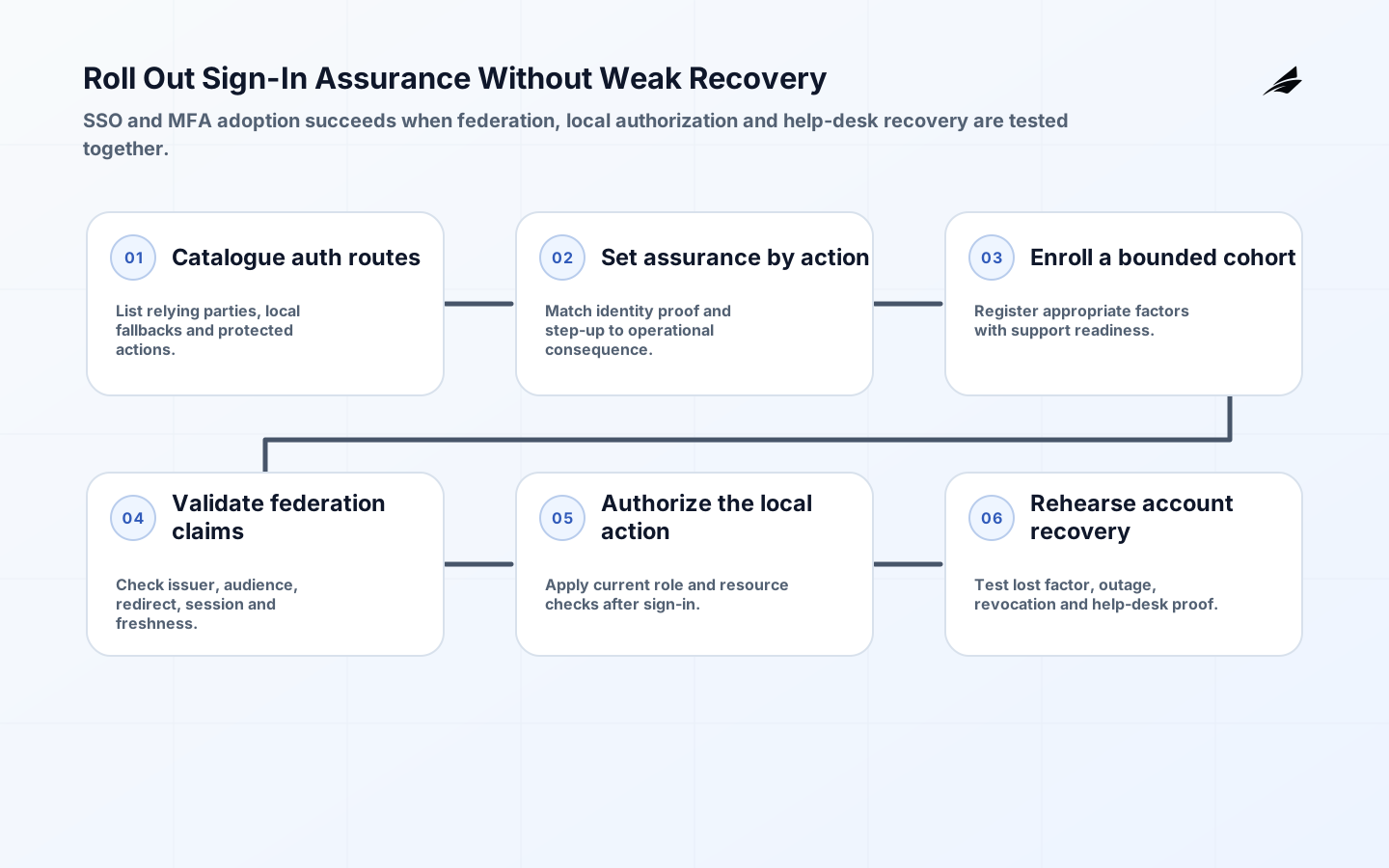
A defensible design begins with trusted inputs and a server-side decision. In this case, federation reduces password handling but does not remove the need to validate issuer, audience, redirect behavior, session lifetime and local authorization. Inventory every relying application, define an assurance and recovery policy, then introduce MFA in cohorts with a documented fallback path. Avoid asking the browser, a spreadsheet or an informal support process to be the ultimate authority. Those surfaces can improve usability, but the service that changes the state or releases the data should reject an invalid request even when another layer is bypassed. Document normal activity, a denied attempt, a temporary exception and a dependency outage so the behavior can be implemented and verified instead of assumed.
- Describe each sensitive operation as a verb applied to a named an interactive sign-in, administrative session, recovery event or federated application connection; vague permissions are difficult to review and test.
- Identify which facts are authoritative, how fresh they must be and what happens when a required fact cannot be obtained.
- Use least privilege and explicit expiry for exceptional access; record the accountable person who approved it.
- Keep policy or configuration changes reviewable and reversible, with a small owner group rather than an unbounded administrator population.
- Build negative tests around lost authenticators, new devices, federation outages, incorrect group claims, session revocation and help-desk identity verification before extending the pattern to less critical workflows.
Follow the SSO and MFA rollout planning decision flow
The diagram for SSO and MFA rollout planning sits after this heading because this topic depends on a sequence that can be inspected, not a slogan. It traces the request and the accountable outcome through the decision points that matter for SSO and MFA rollout planning. The right amount of friction depends on the consequence: a routine SSO and MFA rollout planning task should be clear and fast, while an ambiguous or high-impact action needs a deliberate refusal, challenge or review. Build a recovery route for legitimate users, but make it bounded and attributable so it does not become a quiet expansion of privilege.

| Planning area | Decision to make | Evidence of readiness |
|---|---|---|
| Request context | Capture the subject, intended action, target and workflow state relevant to SSO and MFA rollout planning. | Test fixtures show both expected and hostile request variations. |
| Policy evaluation | Use trusted identity and resource facts to decide whether a person can complete a sign-in only after the application receives and validates the assurance appropriate to the action. | Decision logs or test output explain a permit, denial or step-up. |
| Enforcement | Apply the final decision at the component that owns an interactive sign-in, administrative session, recovery event or federated application connection. | An attempted bypass is rejected by the server, not merely hidden in the interface. |
| Exception and recovery | Provide a limited route when business continuity requires an override or a dependency fails. | Reason, approver, expiry and post-event review are captured. |
Sequence delivery without losing operational control
Treat SSO and MFA rollout planning as an incremental release, not a one-time design workshop. Start with administrators and a willing business group, measure enrollment and recovery friction, then progress by application criticality rather than a single deadline. Before moving to the next cohort, check whether the owner can answer three questions from evidence: who used the workflow, which requests were denied or escalated, and how a legitimate user recovered. This approach keeps the release small enough to reverse while still exercising the identity, data, support and monitoring paths that will matter at scale. It also reduces the temptation to create permanent workarounds during a pressured launch.
Define evidence that helps people make decisions
Metrics for SSO and MFA rollout planning should produce a decision, not merely a dashboard. Track the completion of the protected workflow, denial or challenge reasons, time-bound exceptions, support demand, policy changes, privileged activity and recovery time for the dependencies that affect SSO and MFA rollout planning. Segment results only where the distinction helps an owner diagnose a specific application, customer or team issue and can be handled appropriately. Review the trend with the people who can change policy or delivery: a spike may reflect hostile activity, a flawed migration, confusing guidance or an upstream identity defect rather than one simple cause.
Plan for the failure modes people meet in practice
The expensive problems are often operational rather than exotic. For SSO and MFA rollout planning, a legacy sign-in is left enabled indefinitely, recovery is weaker than enrollment, or support staff can bypass verification without an accountable record. Counter this with a short, tested runbook that tells the right person how to triage the event, what evidence to preserve, which action is reversible, when to escalate and how to record the eventual decision. Ask support and on-call teams to walk through the runbook before launch. Their questions reveal missing permissions, unclear terminology and hidden dependencies that a design review may not expose.
- Rehearse lost authenticators, new devices, federation outages, incorrect group claims, session revocation and help-desk identity verification; record the observed delay and the change needed to reduce it.
- Make ownership visible for every privileged path, automation and third-party dependency.
- Protect logs and support evidence from routine alteration while avoiding secrets and unnecessary sensitive values.
- Review temporary access and emergency changes promptly, then remove them when normal service is restored.
- Retire old routes, credentials and roles rather than relying on informal assurances that they are unused.
Key takeaways
- SSO and MFA rollout planning succeeds when it protects an owned business outcome rather than a generic technology category.
- Write the decisive rule in testable language: a person can complete a sign-in only after the application receives and validates the assurance appropriate to the action.
- Keep enforcement close to the protected operation and use trusted, current context.
- Release a bounded path, test the uncomfortable cases, and expand from observed evidence.
- Make exceptions temporary, attributable and reviewable so continuity does not turn into standing risk.
Frequently asked questions
Where should a team start with SSO and MFA rollout planning?
For SSO and MFA rollout planning, begin with one consequential workflow whose owner, users and dependencies are known. Choose a path that is important enough to exercise the control but narrow enough to reverse, such as one SSO and MFA rollout planning operation rather than every access path at once. Map today’s process, define both the expected and denied outcomes, then add observable evidence and a recovery route before broadening scope. The first release should teach the team how actual people, integrations and support processes react to the new decision.
Does stronger control always mean more friction?
No. In SSO and MFA rollout planning, proportional control matches assurance and review to the consequence of a particular operation. Routine work can remain straightforward when the service has enough trustworthy context. Higher-impact changes may need recent authentication, narrow scope, a second approver, a shorter session or a recorded reason. The aim is a usable and explainable decision for the protected activity, not identical friction for every user and every screen.
Conclusion
A final readiness check is to ask an informed person outside the delivery team to follow one request from intent to outcome. They should be able to identify the protected an interactive sign-in, administrative session, recovery event or federated application connection, the rule used to decide, the person responsible for an exception, the evidence retained and the recovery path if a dependency fails. When those answers are concrete, SSO and MFA rollout planning becomes an operating capability: it supports legitimate work, limits avoidable harm and gives clients a credible basis for continuous improvement after launch.