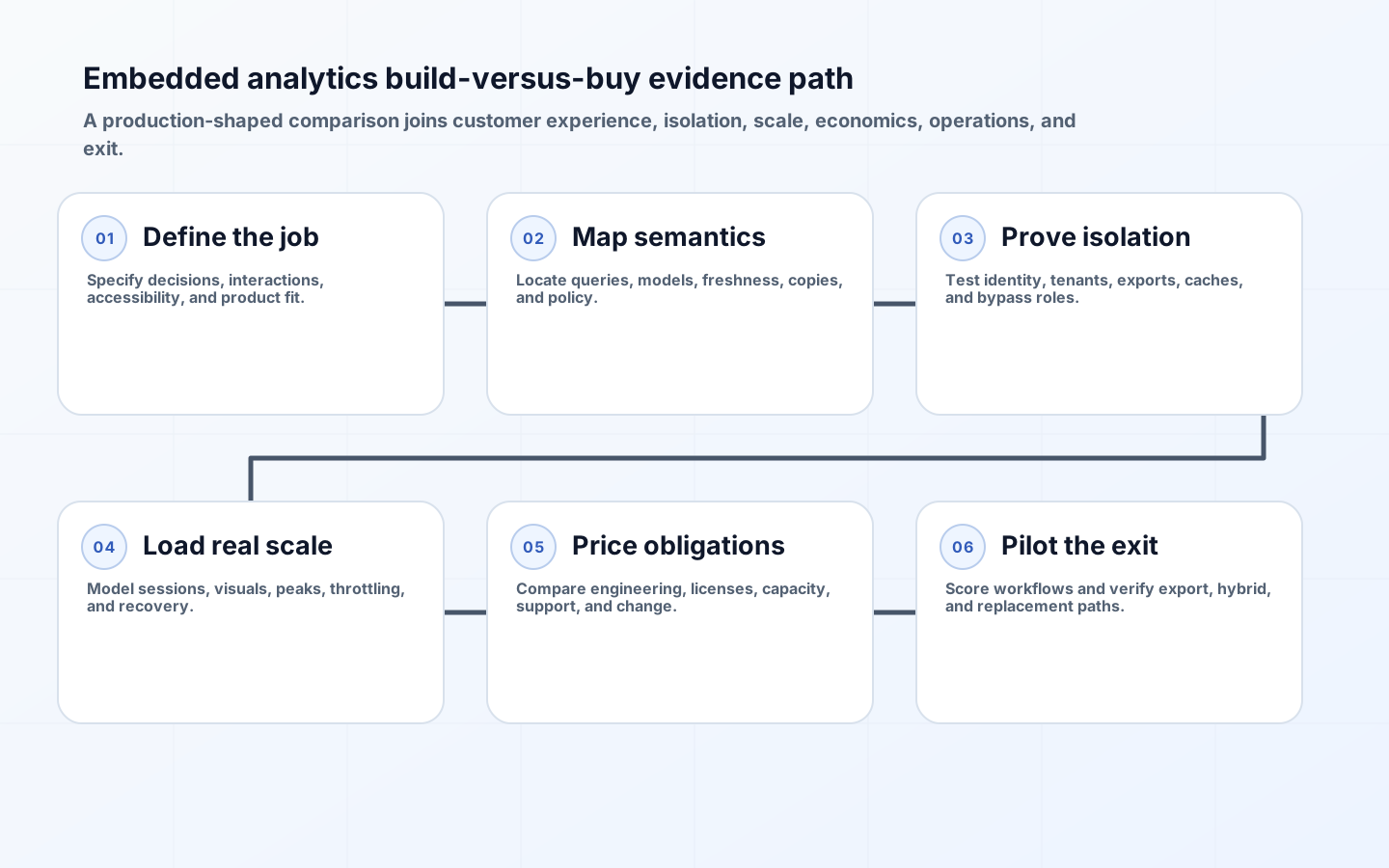
Embedded analytics can mean a chart inside a workflow, a complete dashboard in an iframe, governed self-service exploration, or a customer-facing reporting product with alerts, exports, and authoring. That range makes embedded analytics build vs buy a product decision before it is a library decision. Buying an embedded BI platform supplies modeling, visualization, caching, access, and administration capabilities, but it also introduces licensing, vendor runtime, integration constraints, and an exit problem. Building gives control while making the product team responsible for every analytical behavior users expect.
The right answer is often compositional. A team can buy a semantic or query service and build the product experience, embed a vendor dashboard for long-tail exploration while building high-value workflow charts, or buy most capabilities for launch and replace only proven constraints. Compare options against an explicit experience and operating contract. A feature checklist cannot show whether tenant isolation, latency, accessibility, or commercial terms still work at the expected customer scale.
Define the customer job and experience
Describe who uses analytics, what decision they make, how often, and what action follows. List required experiences: fixed KPIs, cross-filtering, drill, saved views, ad hoc exploration, export, scheduling, alerts, natural-language query, mobile, white labeling, localization, and accessibility. Separate launch requirements from plausible future needs. A support agent needing one account timeline should not inherit the complexity of a full BI authoring surface.
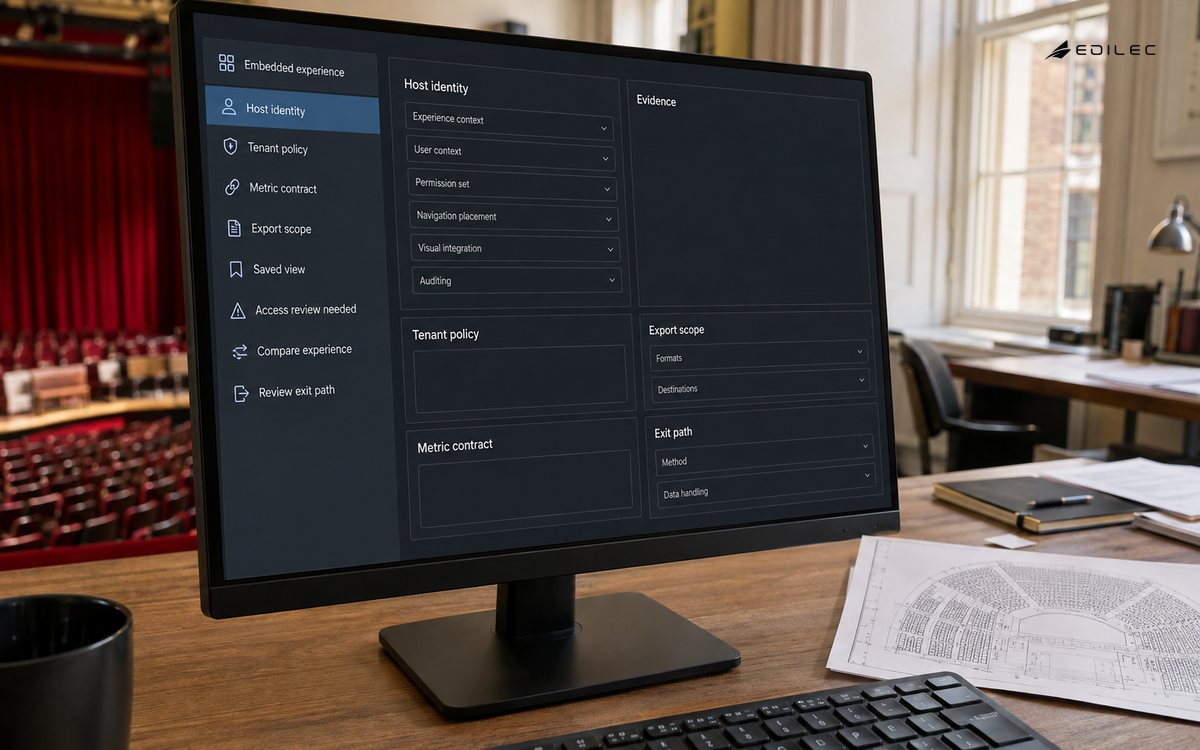
Create UX acceptance tests using the host application. Measure first meaningful visual, interaction latency, navigation continuity, keyboard use, screen-reader labels, responsive behavior, error states, and session expiry. Iframe embedding can accelerate delivery but may constrain styling, routing, event integration, accessibility remediation, and offline behavior. SDK or component approaches may expose more control while requiring greater integration and upgrade work.
| Requirement | Build advantage | Buy advantage | Decision evidence |
|---|---|---|---|
| Product-native workflow | Exact interaction and design | Faster standard dashboard | Prototype with real tasks |
| Ad hoc exploration | Only if deliberately engineered | Mature field, filter, and save features | User research and permission test |
| Accessibility | Full remediation control | Existing support with vendor limits | Independent audit in embed mode |
| White labeling | Complete control | Configuration may be quick | Brand and legal review |
| Exports and schedules | Custom and costly | Often available | Tenant, security, and license test |
Compare data and semantic architecture
Identify where queries execute, where data is copied, how metrics are defined, and how tenant context reaches the query. A platform may query the warehouse live, import extracts, maintain its own semantic model, or combine modes. Evaluate freshness, source load, residency, egress, cache scope, and recovery. If the product already has a governed metric layer, prove that the embedded option can consume it without reimplementing calculations.
For a custom build, avoid placing metric SQL in front-end code or individual API handlers. Use a semantic service or governed query API, stable entity contracts, and server-side policy enforcement. For a purchased platform, examine model version control, testing, CI, APIs, lineage, and promotion across environments. The vendor may reduce authoring work without eliminating analytics engineering. Duplicate semantic models can become the most expensive part of a nominally quick integration.
Prove identity and tenant isolation
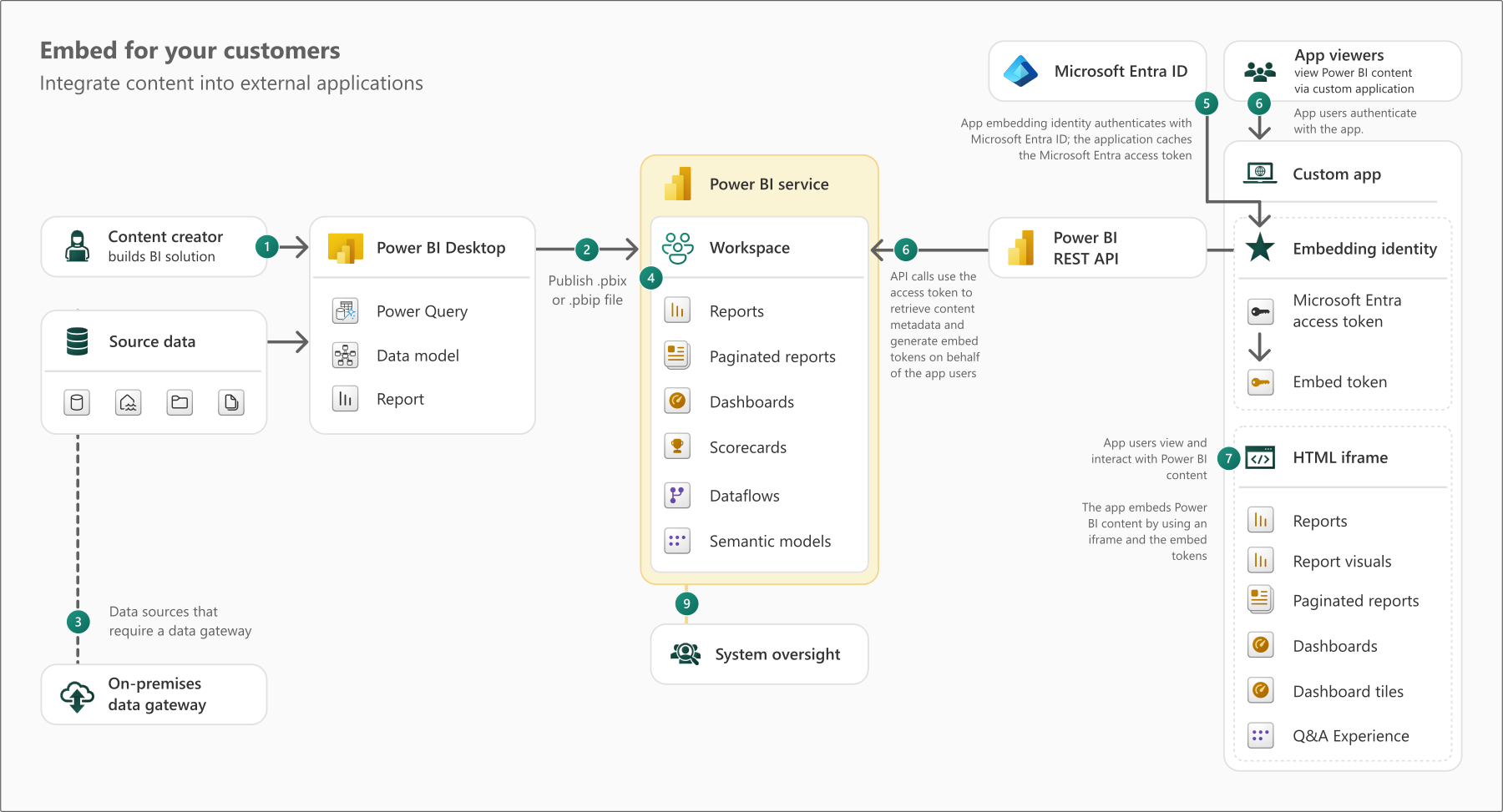
Map the host application's authenticated user to the analytics identity, tenant, roles, entitlements, and locale. Tokens should be short-lived, server-generated, audience-bound, and no broader than the requested content. Never treat a visible filter as a security boundary. Microsoft documents workspace-based isolation and row-level-security approaches for embedded scenarios; the correct model depends on tenant count, customization, operational isolation, and trust requirements.
Test access through default views, edited filters, drill paths, exports, schedules, alerts, cached results, APIs, error messages, and administrative roles. Determine whether platform authors or support staff can access customer data and how that access is audited. For a custom build, enforce row and object policy in the data service and test authorization independently of UI. For buy, review signed embedding, token claims, content permissions, and vendor bypass roles in the exact licensing tier.
Test performance and noisy-neighbor behavior
Model active tenants, users per tenant, sessions, visuals per page, interactions, refresh frequency, scheduled work, extracts, exports, and peak concentration. Test representative data cardinality and row-level policy. A vendor demo with one warm dashboard says little about a Monday-morning peak across thousands of tenants. Measure p95 and p99 load, query fan-out, warehouse work, cache hit rate, capacity saturation, throttling, and recovery after a traffic burst.
Understand scaling units. Power BI embedded analytics uses capacity, and Microsoft documentation ties available compute to capacity size. Other products may license users, sessions, queries, cores, data volume, or a combination. A custom system also has capacity boundaries in APIs, databases, and caches. Isolate premium or high-volume tenants where justified, define per-tenant budgets, and make degradation explicit. A graceful stale view can be better than an indefinite spinner when the analytics service is constrained.
| Cost or obligation | Build | Buy | Often missed |
|---|---|---|---|
| Initial delivery | Product, data, chart, and admin engineering | Integration, model, and vendor setup | Security and accessibility work |
| Run cost | Compute, storage, observability, on-call | License, capacity, warehouse, support | Peak and non-production capacity |
| Change cost | Owned roadmap and compatibility | Vendor releases and API migration | Customer content migration |
| Commercial risk | Infrastructure rates | Pricing metric and contract changes | Minimum commitments and overage |
| Exit cost | Internal refactor | Model, content, user, and workflow export | Historical links and saved state |
Model total cost and commercial exposure
Build a three-year scenario with expected, low, and high adoption. Include engineering, analytics modeling, infrastructure, environments, security review, accessibility, support, upgrades, customer onboarding, and incident response. For buy, include platform license, embedding edition, viewer or creator entitlements, capacity, warehouse queries, data movement, premium support, training, and minimum commitments. Use vendor quotes and contract language rather than public list-price assumptions.
Test the pricing metric against product behavior. Per-user pricing may be difficult when customer seats are elastic; capacity may create attractive marginal cost but require expensive peak headroom; per-query pricing may penalize interactive design. Clarify counting for anonymous users, external identities, service accounts, authors, test environments, paused customers, and internal support. Negotiate audit procedure, overage notice, renewal limits, service credits, data export, and termination assistance.
Compare the operating burden honestly
Buying shifts work; it does not remove ownership. Someone still manages tenant provisioning, semantic models, content releases, permissions, capacity, warehouse performance, vendor incidents, support escalation, and customer communication. Define responsibility for application, data, platform, and vendor layers. Require status and diagnostics that let responders distinguish token failure, model error, source delay, platform outage, and capacity exhaustion.
A build option adds chart rendering, query orchestration, caching, exports, scheduling, accessibility, browser compatibility, admin tools, audit, and upgrade work. Estimate these capabilities from real product scope, not the first chart. A buy option adds vendor release testing and constraints that may not align with the host product. Run failure exercises for expired tokens, regional outage, slow warehouse, bad model release, cross-tenant cache attempt, and vendor API change.
Design a hybrid and exit path before commitment
Keep business metrics, tenant identity, entitlement rules, and source data outside vendor-only content where practical. Inventory dashboards, models, saved views, schedules, alerts, user preferences, URLs, and audit history that would need migration. Test available APIs and export formats. A platform may export data while leaving model logic or dashboard behavior nonportable. Put data return, deletion, and transition support into the contract.
For hybrid delivery, define which experience owns each job. Product-native operational cards can use an internal analytics API, while complex exploration opens a purchased embed with shared metric identifiers. Maintain visual and numeric consistency and avoid asking users to learn two conflicting filter languages. Set a trigger for reevaluation, such as license cost per active customer, an inaccessible critical workflow, or a roadmap dependency the vendor will not support.
Run a weighted production-shaped pilot
Choose two or three high-value workflows and one difficult edge case. Use real tenant distributions with masked or synthetic data, realistic identity, the production warehouse pattern, and expected concurrency. Score user outcome, delivery time, semantics, isolation, performance, accessibility, extensibility, operability, total cost, and exit evidence. Weight criteria before vendor demonstrations so a polished feature does not displace a critical security or commercial requirement.
Record assumptions and sensitivity. A buy option may lead at launch and lose at high active-user volume; a build may appear cheaper only if exports and authoring never arrive. Decide by scenario and set review dates. Do not call the pilot complete until the team has deployed a model change, revoked a tenant, diagnosed a failed query, handled a burst, and exercised a basic content export.
Key takeaways
- Define the customer decision and complete analytical experience before comparing platforms.
- Prove semantic reuse and tenant isolation through the exact embedding mode.
- Load-test realistic tenants, security context, query fan-out, and peak concurrency.
- Model licensing and custom engineering across adoption scenarios and contract terms.
- Assign operations across application, data, platform, and vendor boundaries.
- Preserve portable metrics, identity, and an evidence-backed exit or hybrid path.
Frequently asked questions
Should a startup always buy embedded analytics?
No. Buying can accelerate broad dashboard and exploration features, while a narrow product-native chart may be faster to build. Compare the actual workflow, tenant model, team skills, and likely roadmap rather than company stage alone.
Is iframe embedding a bad user experience?
Not inherently. It can deliver mature analytics quickly, but test navigation, authentication, styling, responsiveness, accessibility, events, and errors in the host application. The fit depends on how tightly analytics must participate in the product workflow.
Can a team build and buy at the same time?
Yes. Use a shared semantic and security foundation, then assign product-native and vendor experiences to different jobs. The hybrid succeeds only when metric meaning, identity, and navigation remain coherent and both paths have owners.
Conclusion
The embedded analytics build-versus-buy decision is a choice about product differentiation and long-term obligations. A production-shaped comparison of experience, semantics, isolation, performance, licensing, operations, and exit cost reveals where a platform creates leverage and where custom ownership is valuable. The best architecture buys mature capability where it is genuinely common and builds the parts that make the customer's decision faster, safer, or distinct.