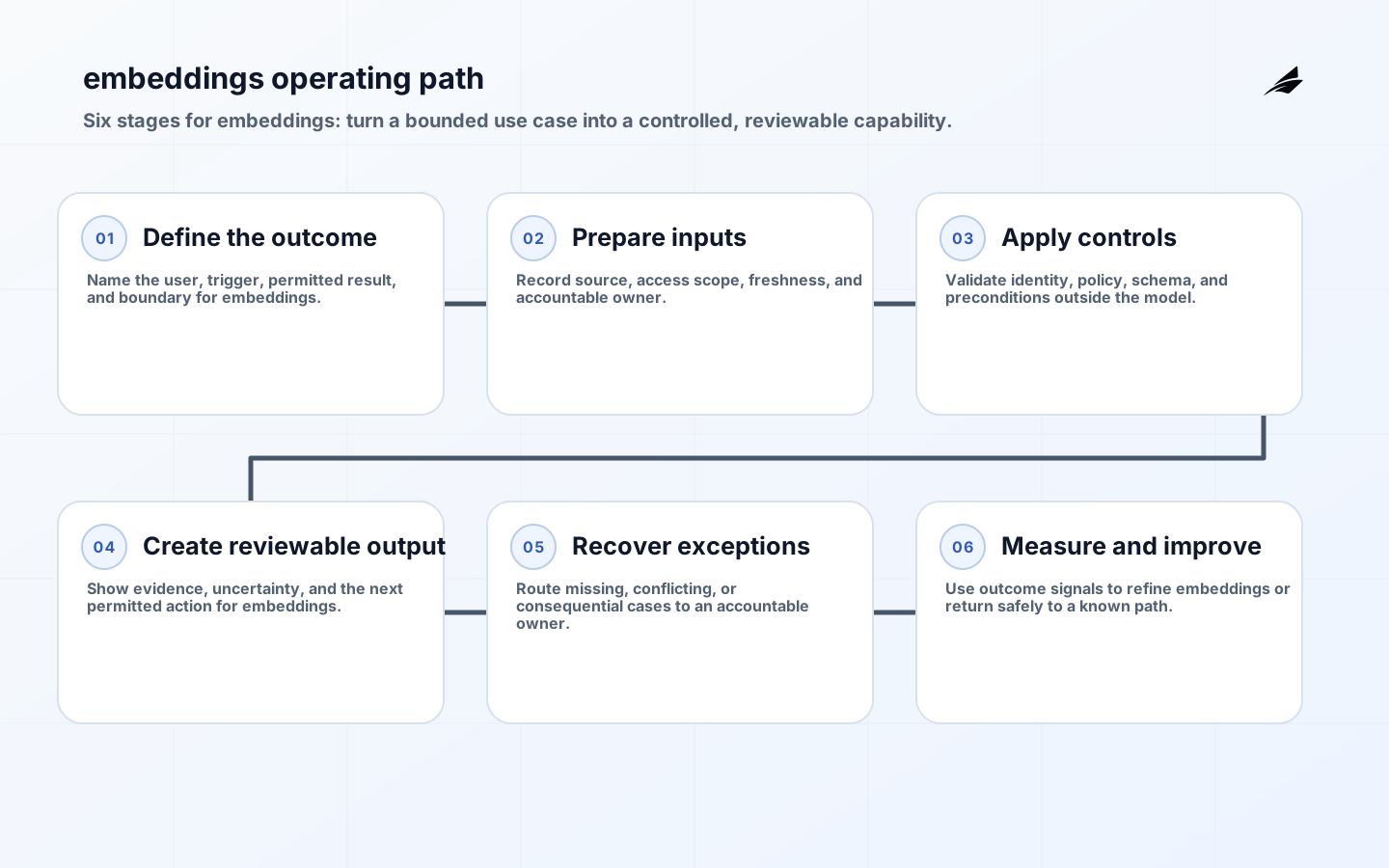
Embeddings are often discussed as a model feature, but for IT managers, they represent an operating decision. In plain language, an embedding is a numerical representation that lets software compare the meaning of items rather than only their exact words. The useful question is not whether the technology sounds capable; it is whether it can retrieve the most relevant approved passages for a service or knowledge task with evidence, accountability, and a recoverable failure path. This guide explains the work boundary, the controls that belong outside the model, and the measures that tell a team whether embeddings are helping real work.
What Embeddings Mean in Practice
A practical embeddings implementation starts with one recurring moment of work, a named user, and a result that can be inspected. A similarity score is a ranking signal, not proof that a passage is current, authorized, or sufficient for a decision. That distinction matters because an impressive demonstration may use curated inputs, invisible permissions, or a person quietly repairing every exception. The NIST Generative AI Profile recommends managing risks across the system lifecycle and context, which is exactly where operational ownership belongs.
| Question | Practical answer | Evidence to retain |
|---|---|---|
| Who benefits? | Name the user and the decision or task that becomes easier. | Workflow owner, trigger, and success criterion. |
| What may enter? | Use approved data, instructions, and tools with an explicit scope. | Source, version, access rule, and effective date. |
| What may happen? | State the permitted output or action and the required review. | Decision rule, approval path, and reason code. |
| How does it stop safely? | Define abstention, escalation, correction, and rollback. | Exception record, accountable owner, and outcome. |
Design The embeddings Boundary
Write a one-sentence service contract before selecting a vendor or framework: “When this trigger occurs, the system may use these inputs to produce this bounded result for this owner.” Then name what it must not decide or change. That contract gives product, security, and operations a shared object to review. It also turns vague concerns about embeddings into testable questions about data lineage, permissions, latency, failure impact, and human authority. The related field guide to embeddings provides useful adjacent context without changing the responsibility of this workflow.
- Define the smallest outcome for which the use of embeddings is genuinely valuable, not merely interesting.
- Keep the authoritative record outside the model and identify the system that owns it.
- Make the user-visible result distinguish facts, inference, uncertainty, and the next permitted action.
- Give exceptions a queue, service expectation, and named owner rather than leaving people to improvise.
Build A Reviewable embeddings Path
The implementation sequence should be create a small, permission-aware corpus; test chunk size and metadata filters against real questions; then add citations and an abstention rule before expanding coverage. Keep deterministic controls at the edges: authenticate the requester, authorize access at the protected operation, validate structured inputs, and persist a correlation identifier. OWASP's LLM application guidance is a useful reminder that prompt and data risks do not disappear because a response is fluent. The goal is a path an operator can reconstruct, not a black box that only works on the happy path.

| Failure condition | Design response | User-safe result |
|---|---|---|
| A policy update is chunked with an older version, so the nearest passage sounds plausible but is no longer effective. | record source version, effective date, access scope, chunk identifier, and the retrieval query beside any consequential answer | The workflow exposes a truthful status and does not overstate certainty. |
| Missing prerequisite | Validate required fields and policy before the consequential step. | The user receives a specific request for information or an escalation. |
| Repeated or delayed request | Use stable identifiers, idempotent processing, and inspectable state. | A retry does not duplicate work or silently change the outcome. |
| Unexpected result | Capture enough evidence to reproduce the path and route review. | The team can correct the record and improve the control. |
Test embeddings Against Real Work
A meaningful test is built from representative work, including uncomfortable cases: incomplete records, conflicting sources, unusual language, a user without permission, and a dependency that responds late. A support lead asks why a customer cannot export data. The system should retrieve the current entitlement policy and account facts, show their sources, and route an ambiguous account state to a person rather than inventing a reason. Test the normal result and the recovery result. Include the people who actually resolve exceptions; they often expose missing context or misleading states that a technical test alone will miss. Keep the fixtures versioned so later changes can be compared with a known baseline.
Operate And Measure embeddings
Measure retrieval recall on reviewed questions, citation coverage, stale-source rate, and the share of responses that correctly abstain. Pair quantitative signals with sampled case review. A metric can show a shift, but a traceable example explains whether the shift came from data freshness, a policy change, a model update, an integration failure, or changing user behavior. The UK guidance for secure AI system development reinforces the need to consider secure design, development, deployment, and operation as connected activities. Review ownership whenever the workflow, source, or user group changes.
Release embeddings With Guardrails
For embeddings, Release in stages: compare the new result with the current process, enable it for internal users or a small cohort, and agree the reversal condition before broader exposure. Record the version of prompts, models, retrieval settings, schemas, policies, and integrations that affect behavior. Do not treat a manual override as a silent fix. Each override is evidence about a missing rule, unclear interface, weak source, or inappropriate boundary. A short recurring review should convert that evidence into a concrete change, test, or documented decision.
Governance And Ownership For embeddings
For embeddings, ownership begins with the corpus rather than the vector index. Content owners should decide what is authoritative, when a document becomes effective, and how withdrawn material is removed from retrieval. Engineering owns ingestion checks and access enforcement; operations owns the questions that define whether retrieved evidence is useful. This division prevents a search-quality problem from being misdiagnosed as a model problem when the real issue is stale policy or unclear stewardship.
Treat semantic similarity as a candidate-generation mechanism. Review the top results for coverage, authority, and contradiction, then test whether the answer cites the right passage rather than merely a nearby one. A release decision should include scenarios where vocabulary changes, documents disagree, and permissions differ between users. Those cases show whether the system retrieves responsibly when meaning, not exact wording, drives the match.
Release Review For embeddings
A durable embeddings programme also needs a clear change-management route. When a new source is added, decide whether it is authoritative for every audience, which metadata determines its scope, and how the team will prove it improved retrieval rather than simply increasing corpus size. When a source is removed or corrected, test that old chunks and cached results no longer influence answers. Keep a small set of business questions as a standing review pack, with the expected source and the reason it is acceptable. That makes it possible to spot a change in evidence quality before users encounter it in a consequential interaction.
Evidence Review For embeddings
Evidence review for embeddings should be concrete. Pick a sample of actual questions, inspect the retrieved passages, and ask whether the answer would remain defensible if the reader opened the cited record. Track questions where the right source was absent, filtered incorrectly, or outranked by a less authoritative document. This review creates a useful distinction between coverage gaps, ranking gaps, and governance gaps. Each calls for a different repair: add approved content, improve metadata or retrieval logic, or change the policy that decides what the system may use. Avoid solving all three with a more persuasive answer.
Embeddings Takeaways
- Embeddings should serve a named workflow outcome with a clear owner.
- Keep source facts, authorization, and consequential side effects under explicit application controls.
- Test failure, ambiguity, and recovery alongside the normal path.
- Use operating evidence to decide whether to expand, correct, or stop the capability.
Embeddings FAQ
Where should a team start? Start with a narrow workflow where the team can retrieve the most relevant approved passages for a service or knowledge task and a human can review the result. What makes it ready for broader use? A team should be able to demonstrate the normal path, a meaningful failure, the evidence behind a result, and a safe correction. Is an AI model the whole solution? No. Embeddings depend on product rules, data quality, permissions, interfaces, and accountable operations around the model. What should leaders ask for? Ask for an owner, an explicit boundary, representative tests, measurable signals, and an exception path that works during a busy day.
Before expanding embeddings, run a monthly source-quality review with the people who own the documents. Sample queries that produced low-confidence or poorly cited answers, check whether the correct document was available and permitted, and record whether the repair belongs in content, metadata, access policy, chunking, or the application experience. This keeps retrieval quality tied to the business record rather than treating it as a mysterious vector-database setting.
Conclusion: Make embeddings Accountable
The useful test for embeddings is straightforward: can the right person understand what happened, see the evidence, and take the next safe action? Build the smallest workflow that meets that test, observe it in real conditions, and widen its scope only when the operating evidence supports it.