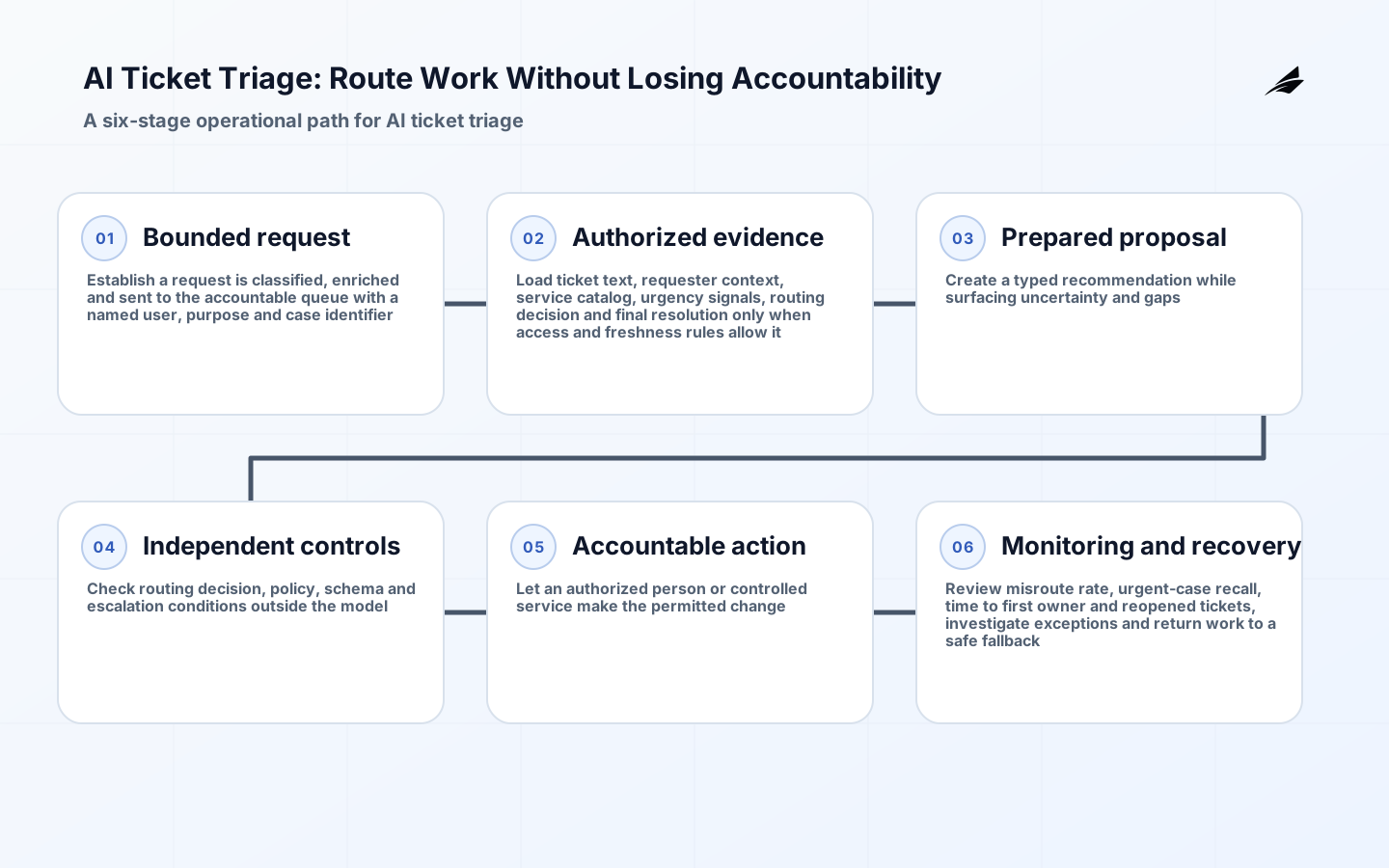
AI ticket triage should be treated as a service that helps internal operations teams make a bounded decision, not as a fluent layer placed on top of an unexamined process. Start with one journey: a request is classified, enriched and sent to the accountable queue. State who owns the result, which record proves completion, and what must happen when evidence is missing. The useful question is not whether a model can produce a plausible response; it is whether the surrounding workflow can detect an unsafe or incomplete response before it affects people, money, access or a regulated record. A credible first release keeps the consequential step narrow, preserves the established manual route, and makes its limitations visible to the worker. That lets the team learn from real work without silently transferring accountability to a probabilistic component.
Define the AI ticket triage operating boundary

Write the task contract in operational language. In this case, the intended outcome is that a request is classified, enriched and sent to the accountable queue. The contract names the initiating event, the permitted user role, the authoritative inputs, the allowed output and the party who owns an exception. The relevant case history includes ticket text, requester context, service catalog, urgency signals, routing decision and final resolution. These are not merely implementation details: they establish what a reviewer can verify later and prevent an attractive answer from being mistaken for a completed business action. Keep the first boundary small enough to describe on one page. Include examples that should complete normally, examples that must pause, and examples that must be rejected. A boundary is mature when support, security and the business owner can independently explain where automation ends.
Choose a system of record for each fact before connecting a model or retrieval component. A user message may explain intent, but it does not replace a current entitlement, a signed policy, a master-data value or a recorded workflow state. Give each source an owner and a freshness expectation. When sources disagree, preserve the disagreement and route it; do not ask the system to improvise a resolution. This matters especially for AI ticket triage, where recurring failure modes include priority errors, sensitive-data exposure, duplicate tickets and unowned escalation. A simple rule is useful: the model may prepare, classify or summarize within its allowed context, while identity, authorization, state transition and durable writes remain independently enforced by the application.
| Boundary question | Decision to make | Retained evidence |
|---|---|---|
| What starts the case? | Define the trigger for a request is classified, enriched and sent to the accountable queue | Request identifier, actor and timestamp |
| What may the system use? | Limit context to ticket text, requester context, service catalog, urgency signals, routing decision and final resolution | Source identifiers, versions and access decision |
| What may it do? | Keep the action aligned with routing decision | Typed output and policy result |
| When must it stop? | Route priority errors, sensitive-data exposure, duplicate tickets and unowned escalation to a named owner | Exception reason and recovery record |
Build controls around routing decision, not prompt wording
Controls should sit at the trust boundary, where the service reads data or affects another system. Authenticate the user and service; bind the request to tenant, role and purpose; then retrieve only records that match that scope. Validate incoming fields and model output against an explicit schema. If an external action is involved, use a separate action gateway that checks authorization, parameters, rate or value limits, idempotency and approval state. A sentence telling a model to be careful is not a permission system. For AI ticket triage, the safeguard must be able to refuse a malformed or prohibited request even when the model expresses it convincingly. Record the decision made by the safeguard as well as the model's proposal.
For delivery teams working on AI ticket triage, this operating decision should connect governed inputs, model behavior, permitted tools, human judgment, and recorded outcomes to evidence an accountable owner can inspect. Design the review experience for a person who is busy and accountable. It should show the proposed result, the evidence used, its age or version, unresolved conflicts, the next permitted action and the reason for any escalation. Avoid hiding uncertainty behind a single confidence number. A reviewer needs enough context to correct the result without reconstructing the entire case, plus a clear way to choose approve, edit, reject or escalate. Preserve those choices as labeled outcomes. They reveal whether errors came from source quality, policy ambiguity, retrieval, the model, integration behavior or the workflow itself. That diagnosis is more valuable than indiscriminately tuning prompts after every correction. In this operating review, move beyond the operating decision only after the owner can show the accepted result, the exception path, and the signal for another review.
| Control | Purpose | Representative test |
|---|---|---|
| Identity and scope | Binds work to an authorized person and record set | A changed account identifier cannot expose another case |
| Schema validation | Rejects unsupported outputs or missing required fields | An incomplete result becomes an exception, not a guess |
| Action gateway | Keeps durable effects outside model discretion | A disallowed parameter is blocked and logged |
| Human escalation | Preserves judgment where consequence or ambiguity is high | A boundary case cannot complete without a named decision |
| Trace and recovery | Supports reconstruction and safe correction | An operator can replay the case and repair the final state |
Evaluate AI ticket triage with cases that resemble production
An evaluation set should be a versioned collection of decisions the workflow actually has to make. Build it from completed cases, deliberately difficult examples and failures that matter to the owner. For AI ticket triage, include ordinary cases alongside priority errors, sensitive-data exposure, duplicate tickets and unowned escalation. Remove or protect sensitive material according to policy, but retain the features needed to judge the result: source provenance, expected route, permitted tools, required abstention and the downstream effect that would be unacceptable. Define a pass before running a candidate. A useful rubric asks whether the output is complete, grounded in allowed evidence, correctly structured, safe to act on and understandable to the worker. The final answer alone is not enough when the route used to reach it can expose data or select an unauthorized action.
Use several kinds of evaluation rather than pretending one score captures operational quality. Deterministic tests are strong for schemas, access checks, citations, required fields, state changes and tool parameters. Expert review is appropriate for usefulness, nuance and the quality of an escalation explanation. Sampling after release tests whether the service still behaves in the context of live data, integrations and users. Segment every result by case type, source, user role and risk tier; an average can conceal an unsafe minority. The measures that should drive a release decision are misroute rate, urgent-case recall, time to first owner and reopened tickets. Pre-agree a threshold, an owner and a response for each measure, so the team does not debate the definition of failure during an incident.
- Version the a single service queue with human confirmation for high-impact tickets and preserve why each case is included.
- Test allowed behavior, required abstention, denied access, stale evidence and dependency failure.
- Check the whole trajectory: context selection, policy decisions, tool calls, handoff and final record.
- Keep a human-readable failure label rather than filing every defect under model quality.
- Re-run the set whenever the model, prompt, source, tool contract or workflow rule changes.
Monitor AI ticket triage as an operating service
Production monitoring is the bridge between a controlled release and durable use. Instrument the work at the case level: request class, allowed context, policy decision, model or configuration version, tool outcome, reviewer intervention, final disposition and time to recovery. Protect sensitive values in traces; the goal is enough evidence to investigate a result, not a duplicate archive of every input. Pair technical signals such as latency, failure and capacity with decision signals such as misroute rate, urgent-case recall, time to first owner and reopened tickets. Review both. A fast service that moves work to the wrong queue, leaks an unauthorized passage or creates reviewer cleanup is not succeeding. Define who reads each signal, how often, and what they can change when it moves.
Alerts require an action, not just a dashboard. Establish a baseline during the limited release, then set thresholds that identify change worth investigating: a jump in correction rate, a drift in input mix, a fall in source freshness, a surge in denied actions or a new concentration of escalations. Do not automatically retrain or widen authority because a metric moves. First freeze the relevant change, examine representative cases and compare them with the baseline. The response may be to repair a source, narrow a route, alter a policy check, add reviewer capacity or disable a capability. Practice the pause path before it is needed: stop new automated effects, preserve evidence, return work to the fallback and reconcile any cases already in flight. A fall in urgent-case recall should trigger a sample review by service owners before the routing model is allowed to continue unattended.
| Signal | Question it answers | Named response |
|---|---|---|
| Outcome sample | Is the completed work still correct and useful? | Investigate cases and constrain the affected route |
| Input or source change | Has the service context changed materially? | Revalidate sources or suspend the affected cohort |
| Control event | Are safeguards blocking or escalating unexpectedly? | Review policy, integration and abuse patterns |
| Recovery time | Can the team restore a correct business state? | Exercise the runbook and resolve ownership gaps |
Release in stages and keep authority reversible
In AI ticket triage, delivery teams should make the relationship between governed inputs, model behavior, permitted tools, human judgment, and recorded outcomes explicit and reviewable. Start with observation or draft mode, where the service prepares work alongside the current process and reviewers retain the final action. Compare its result with the existing route using the agreed rubric. Move next to a trained cohort, not to every user. Give that cohort a clear support path, a visible explanation of the service boundary and an easy way to report a bad outcome. Expansion is a decision that changes risk: wider users may have different permissions, documents, edge cases and incentives. Reassess the task contract and evaluation coverage before increasing data access, action scope or reliance. The accountable owner should be able to show not only a favorable average result, but also the exception route, monitoring evidence and recovery method. This operating review should close the release decision only when the result, unresolved exception, and next review condition are recorded.
A dependable AI ticket triage design makes governed inputs, model behavior, permitted tools, human judgment, and recorded outcomes visible to the owner responsible for this release decision. Change management deserves the same discipline as the first release. A model swap, prompt edit, new source, altered retrieval setting, tool update or revised business rule can each change behavior. Keep a release record that identifies the change, evaluation version, approvals, rollout cohort and rollback condition. Treat policy changes and source changes as first-class deployments, because they alter what the system is permitted to do and what it can support. When a change fails, restore the last controlled state, isolate the affected case set and communicate the impact to the business owner. A quiet workaround is dangerous when it prevents the organization from learning whether the process itself needs repair. The next step in this operating review is justified when the team can trace the accepted outcome, the fallback route, and the owner of follow-up.
Implementation checklist for AI ticket triage
- Name the accountable owner and the exact result for a request is classified, enriched and sent to the accountable queue.
- Inventory ticket text, requester context, service catalog, urgency signals, routing decision and final resolution with source owners, permitted use and freshness expectations.
- Separate model proposals from identity, policy, approval and durable action controls.
- Build evaluation cases for priority errors, sensitive-data exposure, duplicate tickets and unowned escalation before broadening the workflow.
- Set review measures for misroute rate, urgent-case recall, time to first owner and reopened tickets, with thresholds and response owners.
- Exercise disabled mode, manual fallback, reconciliation and communications before launch.
Key takeaways
- AI ticket triage works best when it improves one accountable workflow rather than impersonating a general decision maker.
- Authoritative records, permissions and binding actions need controls the model cannot override.
- Representative tests must include bad, ambiguous and prohibited cases, not only successful demonstrations.
- Reviewer corrections and incidents are evidence for the next release when they are labeled and retained responsibly.
- A measured, reversible rollout makes it possible to pause or narrow the service without losing the business process.
Frequently asked questions
What belongs in the first AI ticket triage release?
Choose a single service queue with human confirmation for high-impact tickets. The first release should have a named business owner, a small user cohort, authoritative input records, a visible review or fallback route, and a short list of measures that could stop expansion. Resist adding unrelated tasks because they use the same model. Each new task changes the acceptable evidence, exception handling and people who may rely on the result.
When should AI ticket triage require human review?
This operating decision for AI ticket triage is strongest when governed inputs, model behavior, permitted tools, human judgment, and recorded outcomes can be reviewed as one operating record. Require review when the outcome materially changes money, access, contractual position, a person's rights, safety, a regulated record or another difficult-to-reverse state. Review is also appropriate when evidence conflicts, required sources are absent, the request crosses a trust boundary or the workflow has not earned confidence in that cohort. Use consequence and evidence quality, not a confidence score alone, to decide the threshold. Acceptance in this operating review requires a visible outcome, a bounded exception path, and a measurable reason to revisit the decision.
Conclusion
AI ticket triage becomes dependable when its limits are explicit: a defined job, controlled evidence, independent authorization, accountable review and a practiced recovery path. Begin with the smallest complete route for a request is classified, enriched and sent to the accountable queue. Test it against the cases that can hurt the business, measure misroute rate, urgent-case recall, time to first owner and reopened tickets, and let the evidence determine whether to expand, revise or stop. That is how an AI-enabled workflow remains useful when the easy cases give way to ordinary operational complexity.