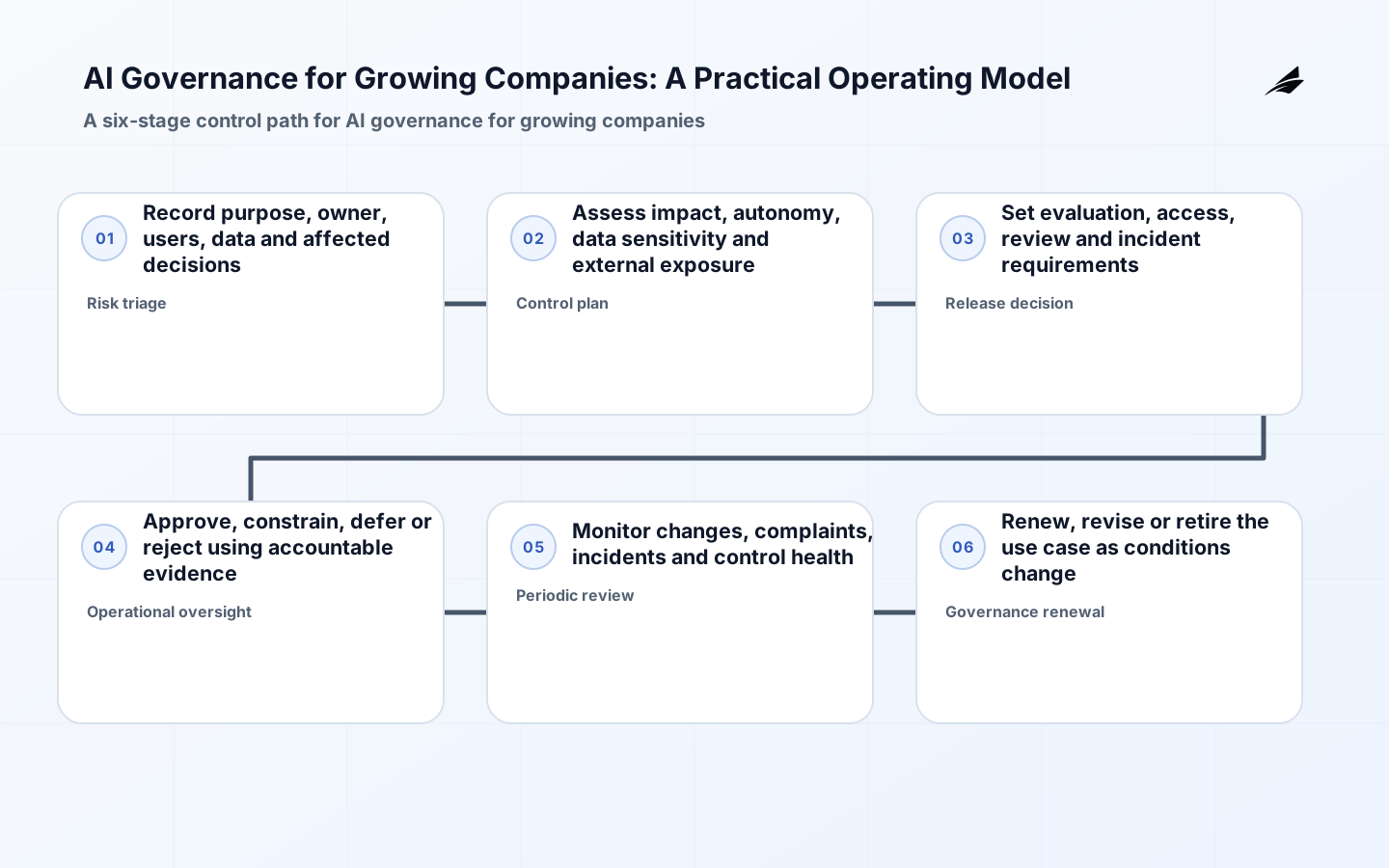
AI governance for growing companies is worth planning as a business service, not as a model demonstration. For enterprise and scaling-company leaders, the first question is whether a defined workflow can make AI ownership, risk decisions and evidence proportionate to the systems that people actually use. Start with a team that proposes, buys, changes or expands an AI-enabled workflow, then describe the durable end state, the people affected and the cost of being wrong. A useful plan distinguishes work that can be prepared by software from a decision that remains accountable to a person or existing system. It also makes uncertainty visible: when facts are missing, policy is ambiguous, permissions do not match or an external dependency fails, the workflow should pause, ask, route or safely do nothing. That discipline keeps early enthusiasm from turning into a broad assistant with unclear authority. The practical goal is a small, observable service whose evidence, limits and recovery path can survive real operating pressure. For this guide, the immediate planning emphasis is use-case ownership, risk triage and lifecycle oversight.
Define the AI governance for growing companies operating boundary
Begin with one representative case rather than a catalogue of features. Write the event that starts the work, the user or system that submits it, the records that may be read, the result that proves completion and the condition that stops automation. In this case, the trigger is when a team proposes, buys, changes, or expands an AI-enabled workflow. The relevant records are use-case inventory, accountable owner, data classification, risk assessment, evaluation evidence, approval record and incident history. Treat each as a governed asset: name its system of record, owner, update cadence and access rule. A model may interpret a message or document, but it should not silently invent missing facts or become the authority for a business state. The boundary is clear when an operator can answer what the service may recommend, what it may change, and which action is deliberately unavailable. This is the foundation for a credible scope, estimate and review plan. For a growing company, start with one use case, a named owner, a risk classification, and the evidence required for approval.
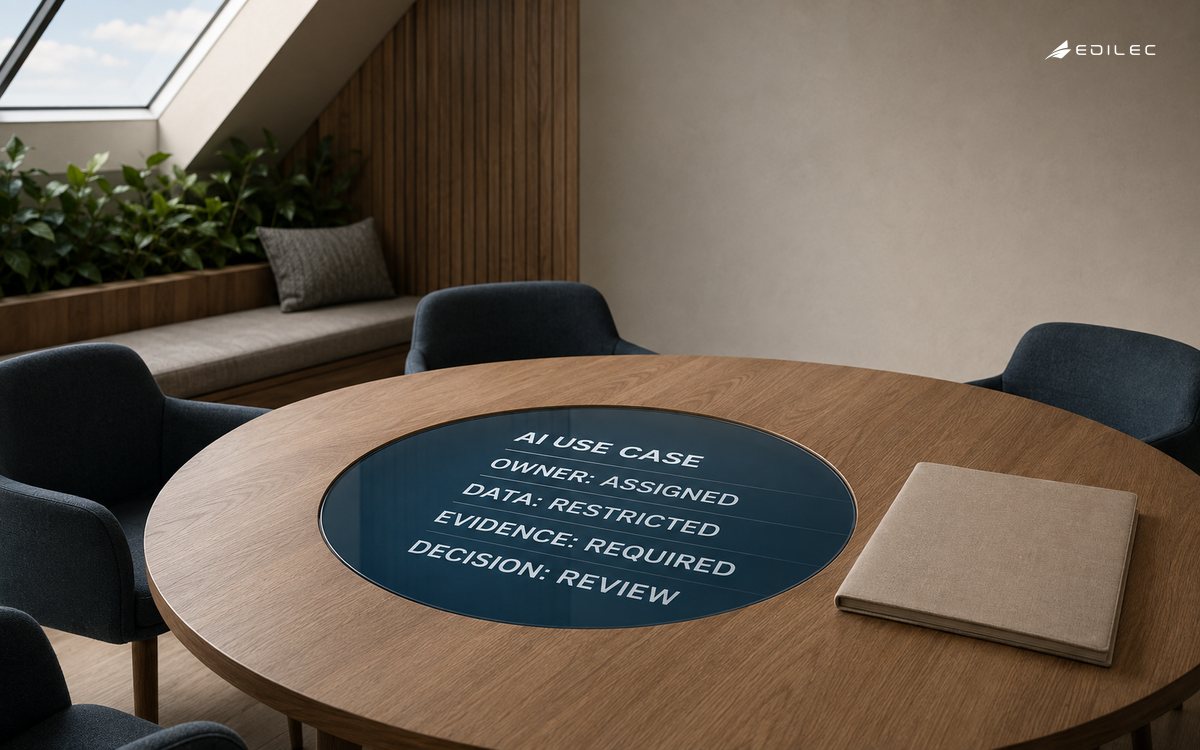
Define success as a verifiable outcome, not a fluent response. Here, the decision is whether the use case may proceed under stated controls, requires a deeper review or should not be used. A client-facing plan should identify the accountable business owner, the technical owner, the data owner and the person who can accept a residual exception. Include normal cases, cases with conflicting evidence, cases that must be refused, and cases that require a named specialist. This turns broad risk language into testable operating rules. It also exposes whether the existing process is ready for automation: inconsistent policies, unowned queues and unclear state transitions are process problems that a model will amplify. Resolve or explicitly contain them before adding model behavior. Test whether the use case can proceed under its stated controls, needs deeper review, or should be refused, with each decision assigned to an accountable owner.
| Boundary question | Decision to make | Evidence to retain |
|---|---|---|
| Who is affected? | Name user roles, accountable owner and escalation recipient | Role map and workflow owner |
| What is authoritative? | Choose source records and freshness rules | Record inventory and source owner |
| What may change? | Separate draft, recommendation and binding action | Action policy and approval threshold |
| When does it stop? | Define missing-evidence, error and risk conditions | Exception queue and recovery runbook |
Design authority, evidence and controls
A dependable design keeps model judgment separate from authority. The surrounding application authenticates the requester, assembles permitted context, validates structured inputs and decides whether a proposed action is allowed. The model can then perform the bounded reasoning task, but its output is treated as an untrusted proposal until independent checks succeed. For AI governance for growing companies, the permitted action is to register the system, set operating conditions, approve a limited release or suspend it. Use typed inputs and outputs, value limits where relevant, server-side policy checks and idempotency for external writes. Do not rely on a sentence in a prompt to enforce permissions. An agent, copilot or classifier must receive the least data and least capability that still lets it complete the assigned task. Keep governance authority in application policy: the model may help interpret evidence, but the organization decides whether to register, approve, constrain, or suspend the system.
Make evidence usable by the person who has to act. A reviewer should see the relevant source, its date or version, the proposed result, the policy or rule that applies, and the uncertainty or missing information. That is materially different from showing a confidence score with no explanation. Design logs for reconstruction rather than surveillance: record identities, authorized scope, tool requests, policy decisions, outputs, approvals and final state; avoid placing sensitive raw material in broadly accessible traces. The NIST AI RMF and its generative AI profile are helpful lifecycle references, while NIST's adversarial ML taxonomy and OWASP guidance remind teams to treat untrusted inputs and model misuse as design concerns, not cleanup work. Give reviewers evidence they can act on, including the relevant source, policy, uncertainty, approvals, and material changes, while limiting sensitive log content.
| Control | Why it matters | Representative test |
|---|---|---|
| Identity and scope | Binds the work to an authorized actor and record set | A user cannot obtain another account through a rephrased request |
| Input and output validation | Rejects malformed or unsupported transitions | A missing required field becomes an exception, not a guess |
| Action gateway | Checks policy outside the model | A prohibited write is denied and recorded |
| Human escalation | Preserves accountable judgment where needed | An uncertain high-impact case cannot complete silently |
| Trace and recovery | Supports investigation and correction | An operator can reconstruct and safely repair one case |
Test AI governance for growing companies against real work
Build an evaluation set from the work the team actually receives. Include ordinary examples, ambiguous examples, stale or conflicting sources, denied-access requests, partial failures and adversarial content. Define what a good result must contain and what is unacceptable before comparing candidates. For this guide, the principal risks are shadow use, unclear owners, inconsistent vendor assessment, policy that does not reach delivery teams, untracked material changes and governance theatre. Test the entire trajectory, not merely a final answer: did the system use allowed information, ask a useful question, select the proper queue, avoid a prohibited action and leave a usable trace? Deterministic checks are well suited to schemas, permissions, required fields and state changes. Human review remains important for usefulness, clarity and whether escalation reasoning makes sense to the people who operate the process. Evaluate ordinary and ambiguous cases, vendor changes, unclear ownership, shadow use, and policy exceptions so governance is measured by decisions rather than paperwork.
Release changes in small, reversible steps. First run in observation mode or produce drafts beside the existing process. Next, invite a trained cohort and compare its completed work with the baseline. Only then consider limited authority for a narrow action that has a clear rollback or reconciliation procedure. A production release needs named incident ownership, change review, a disable switch and a way to remove a bad source or tool permission quickly. Avoid treating live users as the only evaluation environment. Their corrections, however, are valuable evidence: preserve them with enough context to improve the next test set without retaining more personal data than the service requires. Release in reversible stages, comparing a trained cohort with the baseline before granting broader authority, and keep a disable path for incidents.
- Use representative cases from a team proposes, buys, changes or expands an AI-enabled workflow and preserve the reason each case belongs in the test set.
- Set pass and fail criteria before reviewing a new model, prompt, source or tool version.
- Exercise denied access, incomplete data, dependency timeout and manual handoff paths.
- Keep the manual workflow available until controlled release evidence supports a change.
- Review corrections and incidents as inputs to the next versioned evaluation set.
Operate and measure the service
Operational measurement should answer whether the service is helping the workflow, not whether it is generating activity. Track inventory coverage, review completion, overdue controls, incident response time, exception age and evidence freshness. Pair outcome measures with guardrails: a shorter response time is not a gain if it produces more reversals, exposes restricted material or sends harder work to the wrong team. Define every metric with a population, source, owner and review cadence. Sample traces and outcomes regularly, especially after a source, model, policy or integration change. When an incident occurs, distinguish the immediate correction from the underlying control gap. The former restores a case; the latter may require a revised source process, permission, test, threshold or human-review rule. Track inventory coverage, review completion, overdue controls, exception age, evidence freshness, and incident response alongside the effect on business workflows.
Governance can stay proportionate without being vague. Keep a compact register containing the service purpose, accountable owner, permitted data, affected people, model and provider dependencies, risk tier, evaluation evidence, approval conditions, material changes and incident contacts. Revisit it when the workflow gains new tools, handles a new class of data, changes who can rely on the output or increases autonomy. The UK National Cyber Security Centre's secure AI guidance and the NIST resources support this kind of lifecycle thinking: controls must remain effective as the service changes. A review record is useful only when it informs a real decision to continue, constrain, revise or retire the work. Maintain a compact record of purpose, owner, permitted data, risk tier, approvals, material changes, and incident contacts, and revisit it as autonomy grows.
| Review signal | Question for the owner | Possible response |
|---|---|---|
| Outcome quality | Did the workflow reach the right durable result? | Keep scope or repair task logic |
| Human correction | What did reviewers change and why? | Improve evidence, instructions or threshold |
| Control health | Did any proposal cross a policy boundary? | Tighten permissions or add approval |
| Operational burden | Can the named team support exceptions? | Adjust routing, staffing or service target |
| Material change | Has data, authority or model behavior changed? | Repeat risk and release review |
Key takeaways
- Scope AI governance for growing companies around one owned outcome and its exceptions.
- Keep authoritative records, permissions and binding actions outside model discretion.
- Give reviewers evidence, options and authority rather than an unexplained approve button.
- Evaluate real cases and full workflow trajectories before increasing autonomy.
- Use production signals to improve controls, not merely to report volume.
Frequently asked questions
What is the first planning step for AI governance for growing companies?
Name one repeatable case and map it from trigger to durable result, including who owns the result when information is missing. The first useful artifact is a short task contract: user, goal, authoritative records, permitted actions, prohibited actions, escalation path and measure of success. That gives product, operations, security and engineering a shared object to challenge before implementation details harden. Use a task contract to identify the owner, purpose, permitted data and actions, prohibited actions, escalation path, and success measure before implementation.
When should AI governance for growing companies require human review?
Require review when the result changes money, access, contractual terms, legal position, safety, a person's rights or another hard-to-reverse state. Review is also appropriate when sources conflict, evidence is incomplete, the requested action crosses a trust boundary or the workflow has not yet earned confidence through evaluation. The threshold should be explicit and tested; a generic confidence number is not a substitute for a policy decision. Require review for changes to money, access, legal position, safety, rights, or other hard-to-reverse states, and when evidence or authority is incomplete.
When is it reasonable to expand the service?
Expand only when a limited cohort has reached the intended outcome with acceptable corrections, exceptions, reliability and operating effort. The owner should be able to explain failure patterns, pause the service and restore correct business state. Expansion changes the risk profile, so reassess data access, tool scope, user reliance, evaluation coverage and support capacity before granting broader authority. Expand only when the owner can explain failures, pause the service, restore business state, and show that controls still fit the wider use.
Conclusion
AI governance for growing companies succeeds when the organization treats it as a controlled service: a bounded task, authoritative evidence, independent policy checks, accountable people and a path to recover. Build the smallest complete workflow, measure the decision it improves and let observed evidence determine whether the next step is expansion, revision or a well-justified stop. Treat AI governance as a controlled service with a bounded task, authoritative evidence, independent checks, accountable people, and a recovery path.