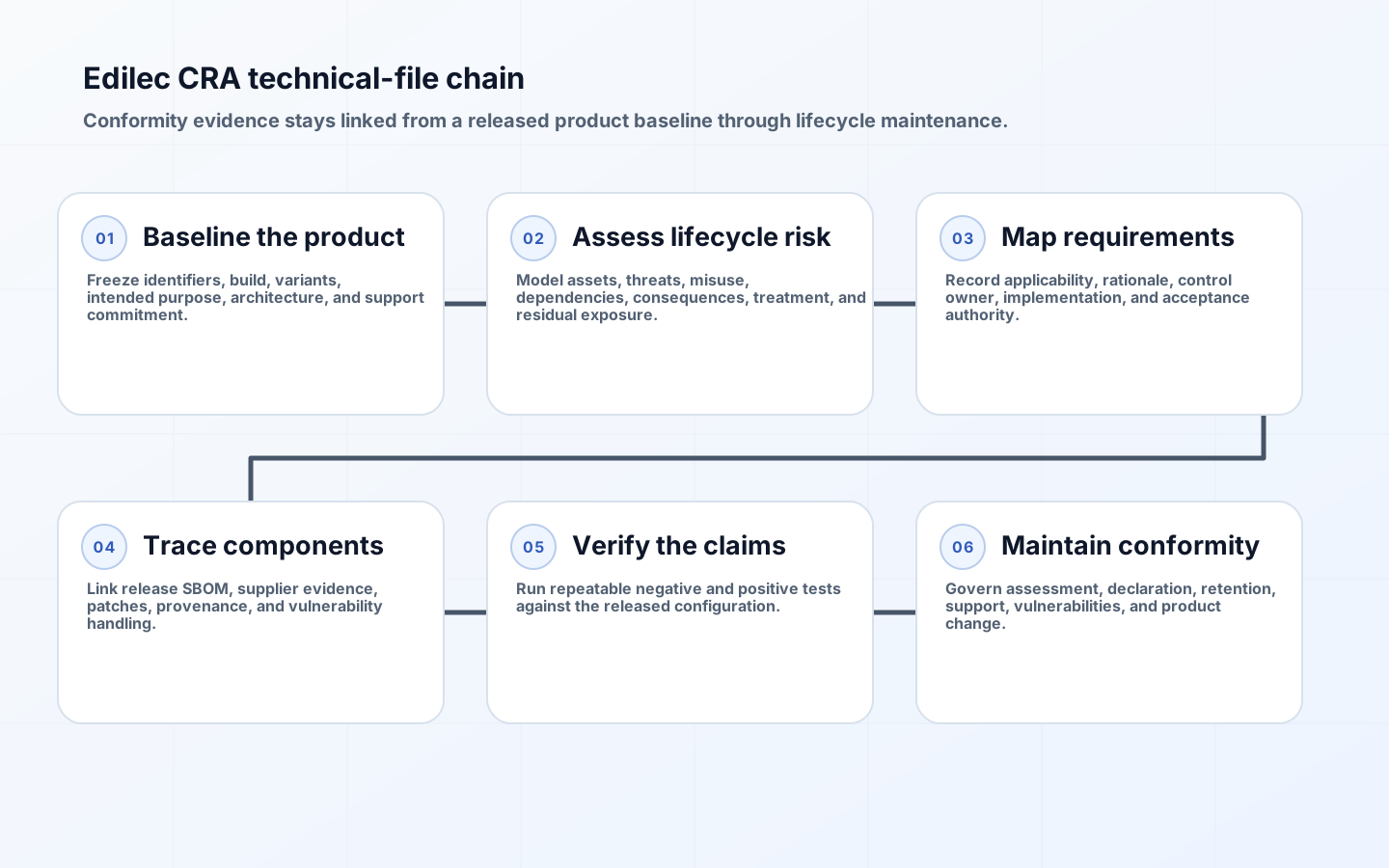
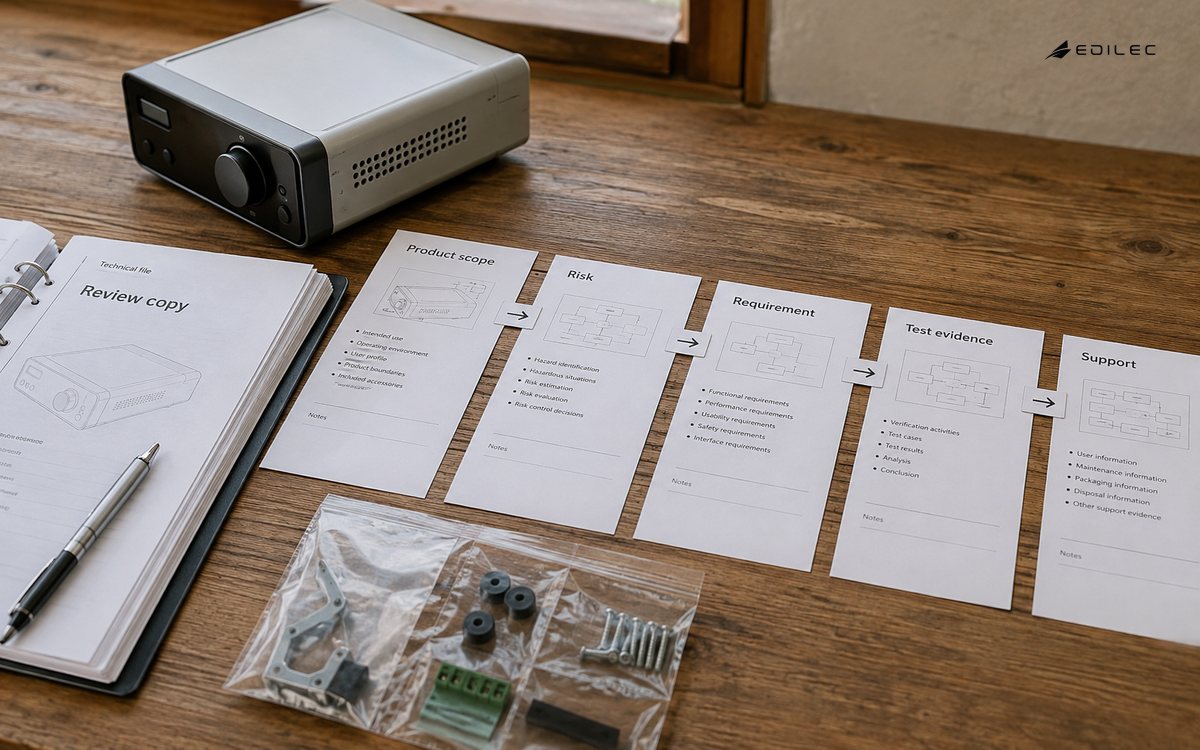
Cyber Resilience Act technical documentation is the maintained explanation of why a released product with digital elements satisfies its applicable cybersecurity requirements. It is not a folder assembled from a penetration-test PDF, an SBOM export, and policy documents shortly before assessment. The file must connect the product description and intended purpose to its risk assessment, chosen measures, design and production information, verification, vulnerability handling, support period, and conformity route. A reviewer should be able to follow a claim to evidence for the exact product version without reverse-engineering the delivery organization.
The Commission's manufacturer guidance puts risk assessment before implementation and requires technical documentation before market placement. Annex VII of the CRA legal text defines minimum content, while Annex I establishes product properties and vulnerability-handling requirements. Build the file as a governed evidence graph: every requirement has applicability, rationale, control, test, result, owner, product baseline, and change history. That structure makes gaps visible before a declaration of conformity depends on them.
Define the product baseline and documentation authority
Create one technical-file index for each product family and conformity boundary. Record name, type and identifiers, intended purpose, reasonably foreseeable use and misuse, hardware and software versions, remote data processing, interfaces, deployment models, manufacturing entities, component boundaries, support end date, and Union market channels. Name an accountable documentation owner and contributors from product, security, engineering, quality, legal, and support. The owner controls completeness and release status; contributors remain responsible for technical truth.
Version the index with the released artifact. Source-control hashes, build provenance, signing identities, configuration profiles, and supported variants prevent a passing test on one build from being attached to another. Define which records are authoritative and which are convenient copies. The compliance-ready delivery guide provides a useful release-control foundation; add CRA requirement mappings and conformity approvals. Restrict confidential details appropriately while ensuring market-surveillance requests can be answered from controlled records.
Design the CRA technical documentation evidence architecture
Use stable requirement identifiers and relationships rather than narrative chapters alone. A requirement record should say applicable, not applicable, or partially applicable, with rationale. Applicable outcomes link to threat or risk scenarios, architecture decisions, implemented controls, verification cases, residual risk, and release approval. Not-applicable judgments cite product facts and an approver. This prevents a future interface or feature from silently invalidating an old assumption. Store large artifacts by immutable reference and checksum instead of copying them into multiple uncontrolled folders.
| Evidence domain | Decision it supports | Authoritative record | Refresh trigger |
|---|---|---|---|
| Product description and intended purpose | Scope, boundary and foreseeable use | Product baseline and architecture | New variant, interface, market or use case |
| Cybersecurity risk assessment | Risk-based applicability and control selection | Versioned risk register | Threat, design, component or usage change |
| Design and production information | Control implementation and reproducibility | Architecture, build and manufacturing records | Release or process change |
| Verification and validation | Requirements are met in the released configuration | Test plan, environment, result and exception | Code, configuration, control or test change |
| Vulnerability handling | Support-period discovery, correction and disclosure | PSIRT procedures and case evidence | Process exercise or real case |
| Conformity decision | Chosen route supports declaration and CE marking | Assessment report and approval | Classification, standard or substantial modification |
Perform a lifecycle cybersecurity risk assessment
Describe assets, security properties, users, trust boundaries, interfaces, deployment assumptions, threat actors, attack paths, and business or safety consequences. Include design and default configuration, production and delivery, installation, operation, updating, maintenance, decommissioning, and reasonably foreseeable misuse. Evaluate exploitability and impact in the product context, identify measures, and document residual risk. A generic enterprise risk matrix cannot substitute for product threats such as malicious update delivery, cross-tenant access, exposed debug interfaces, insecure recovery, or dependency compromise.
Tie every material risk to Annex I outcomes and engineering work. Security by default needs configuration evidence; protection against unauthorized access needs identity and authorization tests; confidentiality and integrity need data-flow and cryptographic decisions; attack-surface reduction needs service, interface, and privilege evidence. Use the security review guide as a release checkpoint, but retain the reasoning and results in the product file. An accepted risk needs an accountable owner, justification, compensating measures, customer information where relevant, and review date.
Document components, SBOM data, and supplier evidence
Maintain component records at a granularity that supports vulnerability decisions. Useful fields include supplier and component name, version, cryptographic hash or package identifier, dependency relationship, source, license, integration location, release inclusion, support status, known vulnerabilities, and supplier contact. An SBOM is one representation of this evidence, not the whole due-diligence decision. Validate completeness against builds, normalize identities, and preserve the SBOM generated for each released baseline rather than continually overwriting one current inventory.
Supplier assessment should match component criticality. For a parser exposed to untrusted content, collect maintenance health, disclosure route, provenance, update history, secure-development evidence, and replacement options. For a low-impact development-only utility, lighter evidence may be proportionate. Document why. The supply-chain security guide helps tier suppliers; CRA evidence must also show how integrated components do not compromise product cybersecurity and how component vulnerabilities enter product handling. Record forks and patches because upstream version labels alone can misstate exposure.
Prove essential requirements with repeatable tests
A test artifact is useful only when it identifies the requirement, product build, environment, data, procedure, expected behavior, actual result, limitations, date, and reviewer. Combine static analysis, composition analysis, unit and integration security tests, abuse cases, configuration checks, fuzzing, penetration testing, update and rollback tests, recovery exercises, and manual design review according to risk. Scanners provide findings, not a conformity conclusion. Document false positives and accepted exceptions with technical evidence.
Create negative tests for default credentials, privilege boundaries, malformed input, network loss, stale updates, revoked keys, unsupported versions, logging failure, and restoration. Verify secure defaults on a factory or fresh-install state, not an engineer's hardened environment. Retest fixed findings against the release candidate and preserve regression cases in CI. The evidence file should distinguish test coverage from successful outcome: untested requirements, excluded variants, and environmental limitations belong in the assessment decision, not a footnote discovered after release.
| Claim | Minimum proof | Unacceptable substitute | Release decision |
|---|---|---|---|
| Secure by default | Fresh-install configuration and attempted insecure path | Configuration policy alone | Block if unsafe default remains |
| Updates protect integrity | Signed update, tamper rejection, rollback and recovery | Successful happy-path update | Resolve trust or recovery gaps |
| Access is controlled | Role, object, tenant and administrative negative tests | UI permission screenshots | Fix server-side authorization failures |
| Known vulnerabilities are handled | Build-linked component match, triage and correction evidence | Unfiltered scanner export | Accept only reasoned residual exposure |
| Security events are observable | Generated event, protected record and response reconstruction | Logging configuration screenshot | Close detection and evidence gaps |
Operate vulnerability handling and support evidence
The technical file must survive placement on the market. Define intake, acknowledgement, triage, coordinated disclosure, component monitoring, remediation priority, secure update delivery, user notification, and CRA reporting. Preserve representative case evidence and exercise results. The product support period should be based on expected use and relevant factors, stated clearly to users, and connected to staffing, signing keys, build reproducibility, test environments, distribution channels, and dependency availability. A published date without funded capability is weak evidence.
For each supported release, know the installed population or reasonable distribution estimate, available corrective versions, adoption, compensating guidance, and end-of-support state. The vulnerability-management guide can structure prioritization and verification. Add product-level awareness and reporting timestamps, customer instructions, and support-period commitments. When a component reaches end of life before the product, document replacement, isolation, maintenance fork, or residual-risk treatment. Review the file after serious vulnerabilities because real cases often expose assumptions that tests missed.
Govern conformity, retention, and product change
Select the conformity route from the product's classification and applicable standards, common specifications, or certification schemes. Record why internal control, notified-body assessment, or another permitted route applies. The Commission conformity page explains the broad options, and the ENISA-JRC standards mapping helps teams navigate candidate standards without itself proving conformity. Preserve assessor correspondence, nonconformities, corrections, declaration approval, and the precise configuration covered.
Change control should ask whether source, component, architecture, intended purpose, remote processing, manufacturing, support, or threat changes invalidate evidence. Classify the change, identify affected requirements, run the selected regression set, update documentation, and assess substantial modification. Keep the technical documentation and declaration for the required period and make retrieval testable. Quarterly sampling should locate a released version, reconstruct its evidence, and answer a hypothetical authority request within an agreed service level. Retrieval failures are documentation defects even when the underlying control works.
Run a technical-file readiness review before conformity approval. Give reviewers a released artifact and ask them to locate the product baseline, applicable requirements, current risk assessment, component inventory, test results, unresolved exceptions, support commitment, and conformity rationale without help from the authors. Sample one security claim in both directions: from requirement to deployed control and from test evidence back to requirement and exact build. Record retrieval time, broken references, stale evidence, contradictory versions, and unavailable owners as defects. This rehearsal tests whether the file can support an authority request and whether knowledge survives staff turnover. Correct the evidence system, not merely the sampled folder, and repeat the review after material architecture or assessment changes.
Key takeaways
- Anchor the technical file to an identifiable released product and conformity boundary.
- Map every applicable requirement to risk, control, test, result, owner, and residual decision.
- Treat SBOMs as release-linked component evidence, not a complete due-diligence conclusion.
- Test negative behavior and secure defaults in the configuration users actually receive.
- Fund vulnerability handling and support-period commitments as operating capabilities.
- Reassess evidence whenever product, component, threat, standard, or intended purpose changes.
CRA technical documentation FAQ
Is an SBOM mandatory evidence by itself?
An SBOM supports component identification and vulnerability handling, but it does not replace risk assessment, due diligence, architecture, testing, or corrective-action evidence. Preserve it for the exact release and connect it to product decisions.
Can a penetration test prove CRA conformity?
No single test covers all essential product and vulnerability-handling requirements. Penetration testing can provide valuable evidence for selected risks, but conformity needs a documented, lifecycle assessment across applicable outcomes.
Must the technical file change for every release?
The file should remain accurate for the released product. Use impact-based change control to update affected baselines, risks, component records, tests, and approvals while avoiding meaningless document churn.
Conclusion
A strong CRA technical file makes conformity inspectable and maintainable. It shows what product was assessed, which risks mattered, how controls were implemented, what testing proved, how vulnerabilities will be handled, and who accepted what remains. Building that chain inside normal delivery is far more reliable than reconstructing it after the product is ready to ship.